
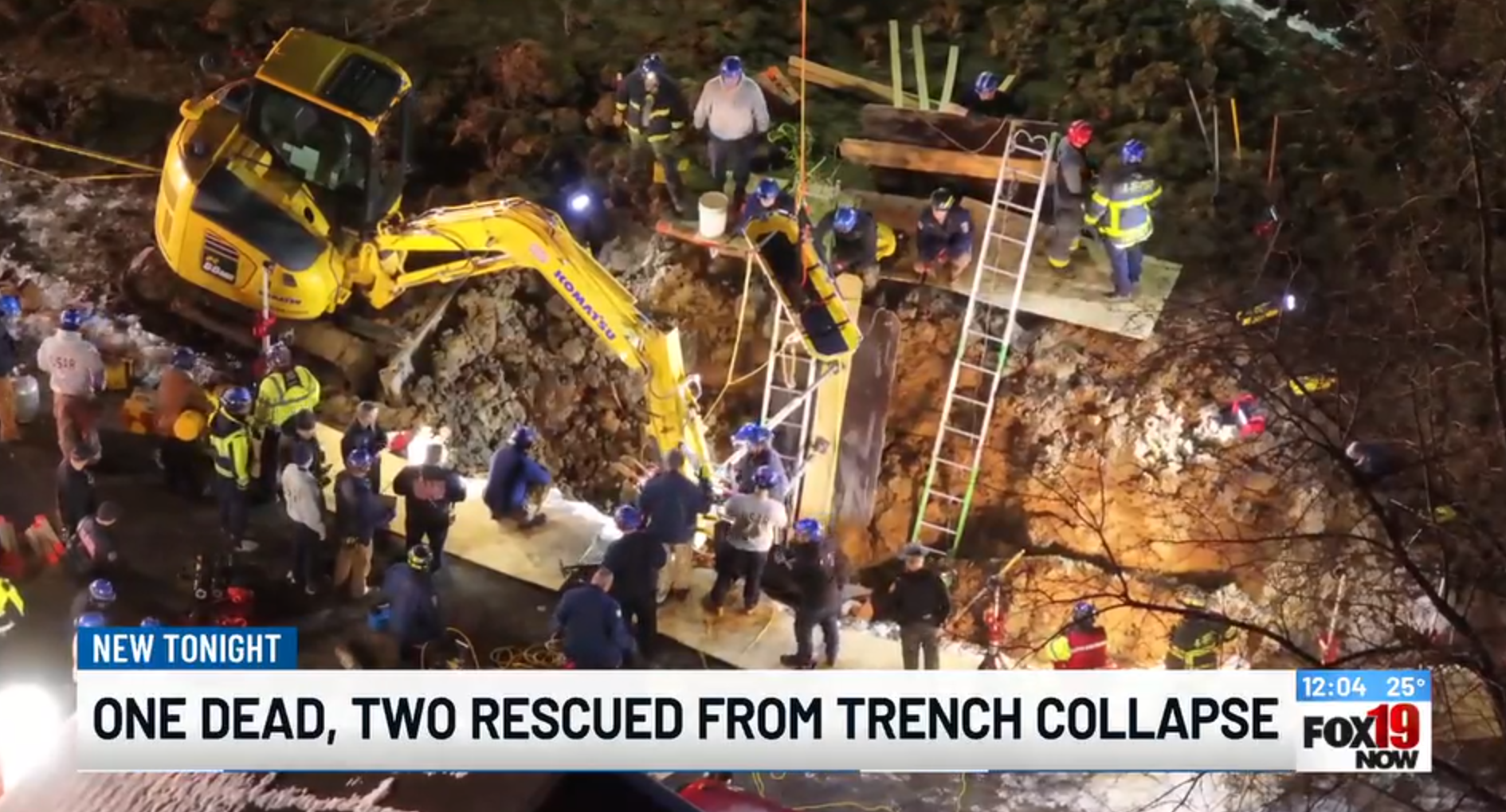
At least five workers were crushed to death in preventable trench collapses in the last month and a half of 2026. Those deaths brought the 2025 total to 17 — the highest number since 2022.
- 61-year-old Miguel Reis of Fall River, Massachusetts was killed and two others were injured in a trench collapse in Yarmouth, Massachusetts November 18. The collapse happened about 8:30 a.m. during ongoing sewer construction. Two people trapped in the trench and a third worker “heroically jumped in” to try and help. The trench kept collapsing as rescuers tried to remove a worker who was buried up to his waist. He was flown to a trauma center in Rhode Island, while the man who jumped in was able to get himself out of the trench and was taken by ambulance to a hospital. Reis was married with two children and was an involved member of the Portuguese community in Fall River, where he had lived for over 40 years. Reis was working for Revoli Construction
- Jose Alberto Barajas was killed when a trench collapsed on top of him in Miami, Ohio on December 5. Two other workers — including Barajas’s father — were rescued and hospitalized. “The trench was approximately 12 feet deep with unstable soil everywhere,” said Hamilton County Urban Search & Rescue Team in a post about the rescue. “Standard trench safety systems, which are normally required and expected for this type of work, were not in place,” the fire department said. Barajas’s loved ones don’t know the reason for the lack of property safety measures, the outlet reported. Now, they’re grieving the loss of his future. Barajas moved from Mexico to the United States on a work visa two years ago. In total, it took first responders six hours to rescue two workers and recover Barajas’s body. All three were Spanish speakers. Officials said it took approximately six hours total to get the two conscious people out of the trench. The trench was reportedly 8 to 10 feet deep, and collapsed a second time as rescue workers were attempting to extricate the survivors.
- 35 year old Donnie Stone was killed when he was crushed in a trench in Big Ridge State Park hear Maynardville, Tennessee; on December 11. Another worker, covered from the waist down, was rescued and taken to the University of Tennessee Medical Center. According to Stone’s brother-in-law, “he was in the process of trying to save another coworker and that’s what led to him getting in the accident is he was trying to save somebody else. As always, he always cared about others.” Stone worked for Norris Brothers Excavating
- 45-year-old Enrique Chub-Cao was killed on December 15 after becoming trapped when a trench collapsed on top of him at a commercial development site in Huntsville, Alabama. The incident happened while crews were digging a drainage ditch during the early phases of constructing a new neighborhood.
- Joe Gutierrez, a City of Spur, Texas Public Works employee died in a cave-in at a utility trench on December 17.
Rinse, Repeat
Making these preventable deaths even more infuriating is that several of these companies had been cited before for unsafe trenches.
Revoli Construction, the company that Miguel Reis worked for, has been subject to at least six Occupational Safety and Health Administration (OSHA) investigations in the last 10 years. In 2023, Revoli was cited by OSHA for three trench-related violations totaling $16,875 (later reduced to $5,625.) The unprotected trench was between 5 1/2 and 7 1/2 feet deep and lacked a safe exit route. Workers were found to be working under a suspended excavator load.
In 2024, Revoli was cited by OSHA and fined $11,585 (later reduced to $6,950) for failing to have safety program which provides for frequent and regular inspections of jobsites, materials, and equipment to be made by a competent person. At the site, two-tenths of a mile from where the fatal trench collapse occurred, OSHA found that workers were “exposed to arc flash, electrical burns, electric shock and electrocution when electrical extension cords with indoor-rated connectors were left lying on wet ground.”
Revoli, which was chosen for the job because they were the low bidder, recently filed a complaint in Norfolk Superior Court against the town of Yarmouth arguing that officials in the seaside community have engaged in “intentional” contract breaches, “work shutdowns,” and “discriminatory conduct.”
But town officials denied Revoli’s allegations, countering that the company’s conduct around the project site has caused “multiple hazards, injuries, and property damage due to poor work and planning,” according to a response and counterclaim filed last month.
According to MassCOSH Executive Director Tatiana Begault, “This is not an isolated accident. This is a pattern of indifference — a disgrace to the labor community and an insult to every worker who leaves home expecting to return safely.” Begault added, “This tragedy is not just a regulatory failure — it is a moral failure. “When a company’s history shows a clear, ongoing disregard for worker safety, allowing them to continue operating without consequences is a betrayal of every worker in the Commonwealth.”
Norris Brothers, where Donnie Stone worked, had received two OSHA citations at the same site earlier this year. The company was fined $24,500 for six serious violations, and $19,600 for another five violations. All but one of the 11 violations were directly related to trench safety. The company is contesting all of the violations. The fines are lower than might be expected for 11 violations.
Meanwhile, there is some good trenching news up in Connecticut. OSHA just issued a $1.2 million citation against Sound Construction, including seven willful and four serious violations related to excavation hazards. The inspection that “found the employer failed to train workers on unsafe trenching and excavation hazards, provide adequate protection from cave-ins, require daily excavation inspections, follow trench shield installation standards, and backfill shields to prevent hazardous movement.”
Why so much? This was a follow-up inspection after Sound Construction was cited in last year after a worker was killed when a 12-foot deep trench collapsed on top of him in December 2023. The company received 2 willful and 5 serious violations for that fatality.
Trench Deaths Rising in 2025 after Falling
By my count, 17 workers have been killed in trench collapses in 2025. There were 13 trench-collapse deaths in 2024, according to OSHA and media reports – a decline from 15 in 2023 and 2022’s record 39 fatalities. Twelve of the 17 workers killed in trench collapses in 2025 have Hispanic surnames.
1. December 17: Joe Gutierrez, a City of Spur, Texas Public Works employee died in a cave-in at a utility trench on December 17.
2. December 15: 45-year-old Enrique Chub-Cao was killed on December 15 after becoming trapped when a trench collapsed on top of him at a commercial development site in Huntsville, Alabama.
3. December 11: 35 year old Donnie Stone was killed when he was crushed in a trench in Big Ridge State Park hear Maynardville, Tennessee.
4. December 5: Jose Alberto Barajas was killed when a trench collapsed on top of him in Miami, Ohio.
5. November 18: 61-year-old Miguel Reis of Fall River, Massachusetts was killed and two others were injured in a trench collapse in Yarmouth, Massachusetts .
6. August 7: Paul Lynville, was digging a ditch in Milton, WV, when he became trapped.
7. July 28: Ronald Baquera Jr., 44, died after becoming trapped inside a 6-foot-deep trench at a worksite in Goodyear, Arizona. (OSHA fined C S Construction, Inc., the employer, twice for a total of $33,100 for violations related to failing to have the excavations properly inspected by a “competent person,” and “not having an adequate protective system” to secure the trench, the records showed. In addition, Core Construction, Inc., the general contractor, was fined $16,550.)
8. July 24: Francisco Rodriguez, 54, died in a cave-in of a 25-foot-deep trench in Kansas City, Kansas. Workers were installing fiber-optic cable when they discovered Rodriquez was missing.
9. July 22: Luis Medrano, 50, was digging when water began spraying up into the trench causing a cave-in in Owings Mills, Maryland. The incident occurred at the construction site for a new elementary school.
10. June 18: Abraham Gomez Cruz, 38, died at the hospital following a trench collapse in Morbank, Texas.
11. June 13: Michael DiRocco Sr., 60, was partially buried in a 5-foot-deep trench that caved in on a residential sewer-line installation project in Norwich, Connecticut. He died at the hospital.
12. April 10: Pedro Sanchez died in the hospital after a trench collapse in Ashburn, Virginia.
13-14. February 28: Emerson Amestica, 24, and Wilmer Barzallo, 32, died after becoming trapped in a trench collapse in Catonsville, Maryland. They were in a 6-foot-deep trench reinforcing a brick and stone retaining wall when the wall collapsed on them.
15. February 17: Anthony Marquet Hollowman, 53, died in a trench collapse for a waterline project in Newberry, South Carolina. The trench was 6 feet deep.
16. February 12: Zachary Frye, a34-year-old senior foreman pipefitter, died in a trench collapse at Jellystone Campground in Sanilac County, Michigan. The trench was reportedly 8 feet deep for a sewer installation project.
17. February 5: An 8-foot-deep trench collapsed in Houston, Texas, trapping two workers. One worker escaped. Coworkers pulled the other, Rafael Vega Cabrales, from the trench and performed CPR, but he died at the scene.
Why Are Trenches Dangerous?
No one should die in a trench collapse.
Every kid who’s ever gone to the beach and tried to dig a hole to China, knows that deep holes tend to collapse. It’s the same with soil. And being covered under several feet of soil is not something you can just dig yourself out of. A cubic meter of soil can weigh 3,000 pounds — the weight of a small car. Even if the worker survives being crushed to death in the initial collapse, the survival time in a collapsed trench can be as little as a minute if there are no air pockets.
And how to prevent trench collapses is not exactly a secret formula.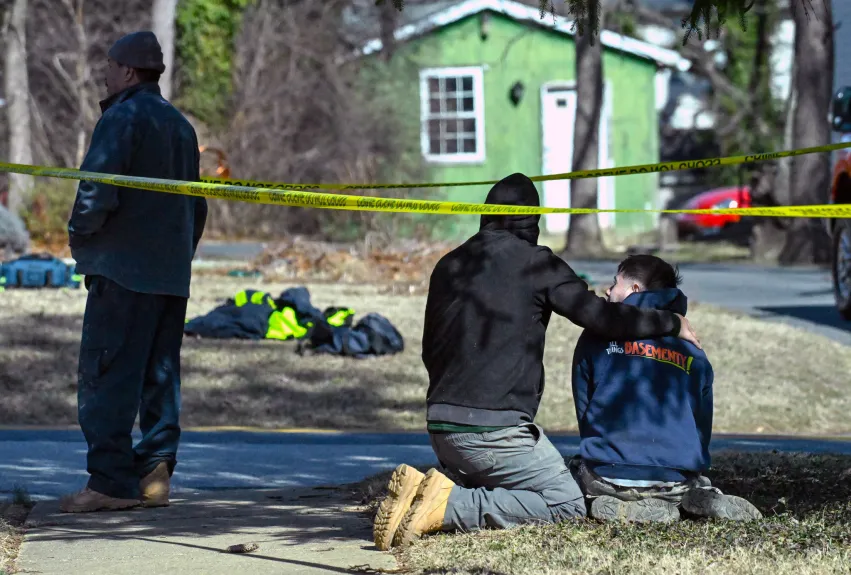
OSHA has had a trenching and excavation standard for over 40 years that sets out required measures for employers to take to prevent trench collapses.
A cubic meter of soil can weigh 3,000 pounds — the weight of a small car. Even if the worker survives being crushed to death in the initial collapse, the survival time in a collapsed trench can be as little as a minute if there are no air pockets.
And determining whether a trench is dangerous is pretty simple. Any trench over 5 feet deep has to be protected — through shoring, sloping or, most commonly, a trench box, and soil and other materials kept at least 2 feet from the edge of a trench. There are other requirements, like a feasible means (like ladders) for workers to quickly exit a trench. One news report estimated that the trench that killed Amestica and Barzallo was only 6 feet deep.
So, workers: what this means is that any trench over a workers head is deadly. Don’t go down unless it’s protected. True, you may be fired. But it’s better than being killed and leaving your family behind.
There’s plenty of information on the OSHA webpage, including a safety video.. You can also go to the Building Trades’ CPWR for a number of resources. Or, you can also try doing a search for “trench safety” on the Google: you’ll get about 46 million hits in less than half a second.
Deterrence Isn’t Working
OSHA can’t be everywhere at once. It’s getting to the point where they can’t be anywhere. As of FY 2024, if OSHA were to inspect every workplace in the country, it would take 185 years. If Trump’s budget is adopted, the figure will soon approach once every 250 years — a quarter of a millennium. (For the historically challenged, it hasn’t even been 250 years since this country was founded.)
Given that OSHA will never have enough resources to visit a significant number of workplace each year, the agency must focus on deterring employers from breaking the law and endangering workers. Deterrence is a function of two factors: the odds of getting caught, and the impact of getting caught. OSHA obviously does not have enough staff to convince employers that there is a likelihood of ever seeing an OSHA inspector — especially the small, hidden construction jobs where most trench work happens. So, if inspections are so rare, then the punishment must be so severe (if caught) that recalcitrant employers will think twice about endangering their workers.
Unfortunately, OSHA penalties are anything but devastating. The maximum penalty for a serious violation is only $16,550 per violation. A willful violation, where the employer either knowingly failed to comply with a legal requirement (purposeful disregard) or acted with plain indifference to employee safety, is ten times that amount, but is difficult to prove. The average OSHA penalty for a serious violation, however, is only $4,597 for federal OSHA, and averages only $2,406 for state plans.
To make matters worse, many state plan states have still not adopted the higher maximum penalties Congress ordered federal OSHA to adopt in 2016.
For example, the earlier citations against Norris Brothers, where Donnie Stone was killed, are low because the maximum penalty for a serious violation in Kentucky is only $7,000. In the previous cases, each serious violation received only $4,900 penalty, probably getting a reduction for “good faith” or “size.” If you are an employer who doesn’t shy away from endangering their workers, the prospect of a $4,900 penalty isn’t going to deter you from much. Even for small employers, that’s the cost of doing business. For larger employers, it’s couch change.
What Is To Be Done?
It’s not hard to find information on how to prevent trench collapses. (When I Google “trench safety,” I get around 51 million results.) What’s hard is getting employers to protect workers by complying with the law. How do we do that?
We Need a Larger OSHA
OSHA is an extremely underfunded agency with an enormous mission: the safety and health of 158 million workers at more than 10.9 million workplaces.
If OSHA were to inspect every workplace in the country just once, it would take 185 years. With that kind of staffing, it’s impossible for the agency to track down every small construction project in the country.
OSHA is an extremely underfunded agency with an enormous mission: the safety and health of 158 million workers at more than 10.9 million workplaces.
The budget for the rest of FY 2025 is due on March 14. The FY 2026 budget must be finished by September 30. OSHA is likely to face severe budget cuts from Republican lawmakers, instead of the substantial increase that workers in this country need. Call your Senators and Congresspersons and demand that the vote to increase OSHA’s budget. And watch this space for updates on budget negotiations.
We Need Stronger OSHA Enforcement
OSHA issued a National Emphasis Program (NEP) to prevent trenching deaths in 2018. When the epidemic of trench deaths became evident in mid-2022, OSHA renewed and recommitted its focus compliance assistance and enforcement resources on trench safety. The following year, the number of trench collapses was cut in half. Still far too high, but it was progress. But they’re back up again in 2025. Question: Will the Trump administration continue the NEP?
OSHA Needs Higher Penalties
OSHA penalties are too low to impact the behavior of all but the smallest of companies, and as a recent Washington Post article showed, OSHA doesn’t have the authority to shut down even the worst companies that kill workers.
Although OSHA’s maximum penalties are set by law, the agency has discretion over how high individual penalties are, how many violations will be cited, and whether penalties will be “serious” or “willful,” which carry much higher penalties. A willful violation occurs when an employer intentionally disregards or shows indifference to Occupational Safety and Health Administration (OSHA) requirements or employee safety.
In FY 2023, the average penalty for a serious violation was $4,597 for federal OSHA and only $2,406 for OSHA state plans.
For a serious violation of an OSHA standard (one capable of causing death or serious physical harm), the maximum penalty is $16,550. For a “willful” violation, the maximum penalty is 165,550, but willful violations are rare. And actual penalties for serious violations are generally much lower than the maximum. In FY 2023, the average penalty for a serious violation was $4,597 for federal OSHA and only $2,406 for OSHA state plans.
To make matters worse, several OSHA state plan states still refuse to raise penalties to the level that federal OSHA raised theirs in 2016
And don’t cry for small employers who might be seriously impacted by OSHA penalties. Every state has a federally funded Onsite Consultation Program that proves no-cost, confidential consultations to help employers identify and address hazards and establish or improve safety and health programs.
But if we are to seriously tackle trench collapses, OSHA needs to issue more willful violations. Will the Trump administration use aggressive enforcement and high penalties to address the problem effectively? Color me skeptical, but I’d love to be proven wrong.
Criminal Prosecutions for Trench Collapses
OSHA is far too small, and OSHA penalties are far too low. But there is another tool: Nothing focuses the minds of employers who cut corners on workplace safety than the prospect of spending time in jail.
OSHA’s hands are tied when it comes to criminal prosecutions. The Occupational Safety and Health Act (OSHAct) only allows a criminal prosecution when there has been a willful violation related to a workplace fatality. Those cases are almost always referred to the Justice Department which then must decide whether to prosecute. Because the OSHAct makes a criminal prosecution a misdemeanor instead of a felony, DOJ is often reluctant to put the resources into prosecuting such cases.
OSHA is far too small, and OSHA penalties are far too low. But nothing focuses the minds of employers who cut corners on workplace safety than the prospect of spending time in jail.
And these days, DOJ has far better things to do — like going after former Biden administration officials and never-Trumpers.
But local prosecutors have no such restrictions. They can use homicide and manslaughter laws to pursue criminal prosecutions for worker fatalities. One thing OSHA can do is to work more closely with local prosecutors to pursue these cases.
Rena Steinzor recently wrote about a trenching death prosecution in Travis County, Texas. Last November, Travis County District Attorney Jose Garza filed one of the country’s handful of criminal cases motivated by a typically hideous death in a trench. A grand jury charged D Guerra Construction LLC and Carlos Gerrero, the supervisor at the site, with criminally negligent homicide in the death of Juan Galvan Batalla, 24. Gerrero had been sent back down an unprotected trench after he had escaped a collapse in the same trench earlier in the day.
In 2022, the King County Prosecutor’s Office in Washington charged construction company owner Phillip Numrich with felony second-degree manslaughter and violation of labor safety regulation for alleged negligence that caused the 2016 death of 36-year-old Harold Felton. Felton was crushed to death under more than 6,000 pounds of dirt when a 10-foot deep trench caved in on top of him at a West Seattle home.
(Unfortunately, instead of the manslaughter charge, the prosecutor’s office later backed down and reached a settlement with Numrich, where he pleaded guilty to the crime of Attempted Reckless Endangerment, a simple misdemeanor and agreed to serve 45 days in jail. Numrich also had to pay a fine of $100,000, in addition to the original L&I fine, and serve probation for 18 months, limiting his contact with the Felton family and the type of work his company can perform.)
Workers Need to Be Organized and Educated
Like the two workers killed last week in Maryland, most construction work — especially small jobs by small companies you see around the neighborhood — is done by immigrant workers who speak little English and may be undocumented. (The large, federally funded programs are much more likely to be done by union workers. And you’ll usually see the use of trench boxes.)
Almost none of the workers in small construction companies belong to unions and even if they understand that the work is dangerous, they are generally reluctant to complain or file an OSHA complaint for fear of being fired or reported to ICE. Some of these workers, however, may have some contact with local worker rights groups that have access to health and safety information. Health and safety activists and COSH groups around the country are working with these workers and worker rights group to ensure their safety.
Do It Yourself
Of course, as I’ve written many times before, you don’t need to hope that an OSHA inspector shows up when you see an dangerous trench in your neighborhood. Even though OSHA (and state OSHAs) are far to pressed to monitor every small construction site in the country, most trenches I run across are located in plain site of anyone who happens to be walking by. As I mentioned above, it’s fairly easy for an amateur to determine if a trench is hazardous — if it’s over a worker’s head and there is no trench box or shoring, then it can kill. (Fall hazards are also easy: the employer is violating OSHA’s fall protection standard if any worker is working above 6 feet with fall protection.)
If you’ve often fanaticized about being a real live brave OSHA inspector, but went into some boring, less productive private sector occupation instead, I’ve written a do it yourself workplace safety protection post to show how you can emulate your heroes at OSHA.
When you run across a hazardous trench, take pictures, talk to the supervisor, and if that doesn’t get workers out of a dangerous trench and you feel like they’re in imminent danger, call your local OSHA Regional or Area Office or 1-800-321-OSHA. If it’s not urgent, file an OSHA complaint online.
More Reading
There have been two powerful and hard-hitting investigative pieces on trench collapses over the past few years:
Death in the Trench, by veteran investigative reporter Jim Morris.
250+ workers have died in preventable trench cave-ins over a decade, probe finds, NPR, and a related Texas Public Radio piece.
The cities/towns that have trench work in their jurisdictions should require that the contractors do not have outstanding citations from OSHA or poor safety records. And the towns’ inspectors should have a basic understanding of workplace safety so they can report unsafe conditions to OSHA.
All good points. One additional: Cities also must have the will to shut down unsafe operations. jordanbarab.com/confinedspace/2023/06/05/city-turns-contractor-into-osha-for-trench-hazards/