
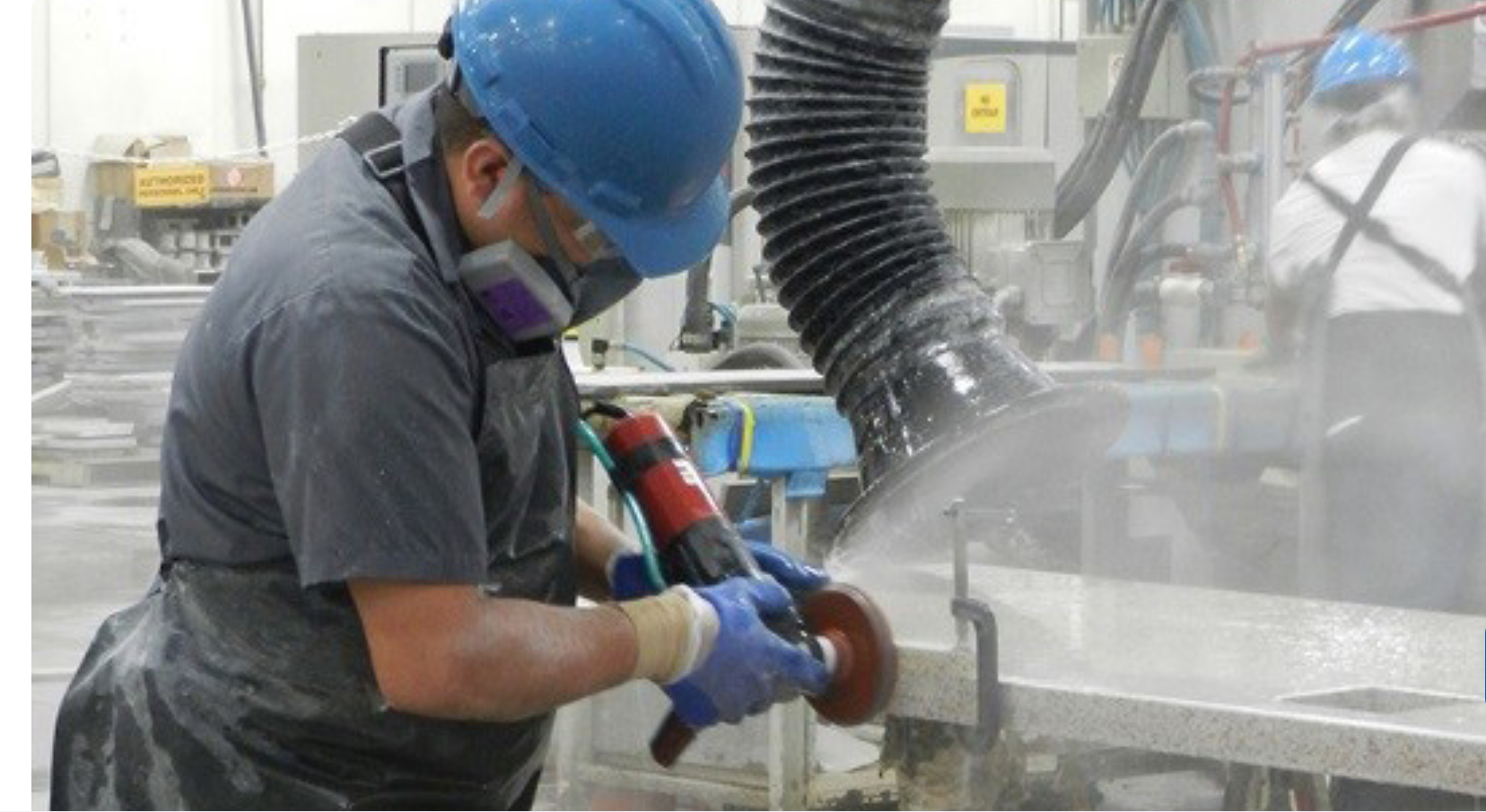
A very new, yet very old and always deadly health specter is haunting American workers: acute silicosis.
It’s not your father’s silicosis: usually developed over a long career of exposure to relatively small amounts from sawing through concrete or working in foundries, coal, gold and metal mines, or granite and sandstone quarries. These are case of “acute silicosis,” once rare but now becoming increasingly common in men as young as their 20s and 30s who have been working in the industry for an average of only 10 years.
The cause: manufactured kitchen countertops that look like real marble, but is less expensive and contain an enormously high silica content.
OSHA issued a silica standard in 2016 mainly addressing hazards faced by foundry workers and construction workers who saw through concrete and stone. Workers were required to either wet down the material or use respirators. MSHA followed in 2024 with a silica standard protecting miners a very severe and deadly from of silica-related black lung disease. (Although the Trump administration continues to delay enforcement.)
I’m not going to spend a whole lot of time right now writing about this problem because some of this nation’s leading health journalists have picked up the story. I have linked the best stories below.
But just to give you some background…
Some Background
The manufactured (fake stone) countertops that many Americans have in their kitchens, often marketed as “quartz,” are made from material that contains extremely high concentrations of silica dust. — often more than 90% — compared to natural stone such as granite (30%) or marble (less than 10%).
Engineered stone is typically composed of crushed quartz bound with resins and pigments. When power tools cut and fracture the surface into small respirable particles, they lodge deep in the lungs. Repeated exposure triggers inflammation and fibrosis. Once scarring begins, it can’t be reversed.
California’s state Health Department has confirmed 519 silicosis cases from engineered stone and 29 deaths since 2019. Deaths increased by 100% in L.A. County last year. 98% of all cases are Latino men, many of whom are undocumented. The median age at diagnosis is 46; the median age at death, 49. Many of these workers need lung transplants, but they are risky, expensive and only last around 5 years.
Alice Berliner, director of the Office of Worker Health & Safety for Los Angeles County Department of Public Health, says there are an estimated 4,000 countertop workers in California, which means so far, about 12% have developed serious illnesses. But these figures are likely an undercount as Former OSHA head Dr. David Michaels described in recent Congressional testimony:
As staggering as these statistics are, they undoubtedly underestimate the true incidence of the disease because many of the workers in this industry do not speak English, are unauthorized, do not have regular sources of medical care, or are afraid of entering the medical system. Untold numbers currently exposed will get sick in the coming years even without additional exposure.
In addition to California, cases are appearing in countertop fabrication shops from in Texas, Florida, and the Northeast.
Sheiphali Gandhi, an occupational and environmental pulmonologist at UCSF, warned that the true burden remains uncertain. “We’re missing cases,” she said. “There’s no national surveillance system for this.”
In 2024, California passed the first law in the nation to address the growing epidemic. The new law imposed stronger regulations on the industry by banning dry cutting of stone countertops, mandating that employers provide adequate training and requiring the state health department to provide education about silicosis prevention and diagnosis to the affected workforce.
The Western Occupational & Environmental Medical Association has petitioned the California Occupational Safety and Health Standards Board to prohibit all fabrication and installation tasks on artificial stone that contain more than 1% crystalline silica.
Workers and doctors say that wet processing is insufficient because the resulting wastewater eventually dries into dust. Other protective measures, including robotic cutting, ventilation and protective gear, are too expensive for most small shops.
To the Rescue: Of Manufacturers
But never fear, Republicans in Congress are riding to the rescue…of the countertop manufacturers, not the workers.
Workers in the United States are not permitted to sue their employers, so affected workers are suing the manufacturers who are failing to enforce safe conditions on their customers even though they know that their products are killing workers.
More than 370 lawsuits have been filed by workers who say engineered stone manufacturers failed to warn employees about the risks or sold a product that cannot be fabricated safely.
Writing to the rescue of the countertop manufacturers, the Representatives Tom McClintock (R-CA) and Andy Biggs (R-AZ) introduced a bill that would bar lawsuits against manufacturers or sellers of engineered stone for injuries that resulted from cutting the product in third-party facilities
According to former OSHA head David Michaels, if the industry receives immunity from liability, “all bets are off. -+There’s no stopping the number of silicosis cases we’ll see around the country.” Passing H.R. 5437 “would be a death sentence for workers exposed to silica.”
The bill that would put quartz in the same category as vaccines and firearms, products whose manufacturers are shielded by federal law from injury lawsuits.
Republicans invited countertop manufacturers, such as the US’s biggest manufacturer, Cambria, to a House Judiciary Committee hearing. The companies pleaded not guilty, blaming the poor practices of down-line fabricators who employ workers who cut stone. The material is perfectly safe, they argued. It’s the irresponsible downstream fabricators whose unsafe working conditions are killing workers.
Michaels calls that claim “comparable to the tobacco industry saying cigarettes are safe.” I guess that makes sense. Tobacco is perfectly safe. Unless you inhale its smoke. Asbestos is also perfectly safe — unless you inhale or ingest it.
“In my years in occupational health, I have never seen an industry say, ‘We sell a dangerous product but we have no responsibility for it once it leaves our factory, and rather than protect workers downstream, we are the ones who need protection from lawsuits,'” says Michaels
“It’s not a few bad actors,” said Raphael Metzger, a product liability attorney who has filed roughly 200 silicosis-related injury cases and a class action seeking medical monitoring. He said the issue is the product’s composition, not isolated regulatory noncompliance.
Committee Republicans accused Democrats of trying to drive the industry out of business and accused OSHA of failing to do its job enforcing current regulations. Yet Biggs, one of the bill’s main co-sponsors, introduced a bill to abolish OSHA last year
Michaels, who testified for Democrats at the hearing, observed that “There was this very clear chasm between the Republicans, were primarily interested in protecting corporations, in particular, Cambria, and the Democrats, who wanted to talk about how they ensure that workers who have silicosis get justice and how to address the silicosis epidemic.”
According to Michaels, if the industry receives immunity from liability, “all bets are off. There’s no stopping the number of silicosis cases we’ll see around the country.” Passing H.R. 5437, he told Inside Climate News, “would be a death sentence for workers exposed to silica.”
He pointed out in his testimony that lawsuits are often the most effective way to change companies’ behavior. He cited lawsuits twenty years ago against companies manufacturing diacetyl, an artificial popcorn butter flavoring that obliterated workers’ lungs. After losing numerous costly lawsuits, the industry switched to a safer alternative.
Michaels suggested that the manufactured countertop industry look for safer substitutes, such as slabs made from recycled glass and other safer materials.
Australia confronted the same problem in the late 2010s. After a study found that almost one-quarter of workers fabricating engineered stone had silicosis, in 2024 they prohibited the manufacture, supply, and installation of engineered stone containing high levels of crystalline silica.
They concluded that even with controls, fabrication of high-silica engineered stone posed unacceptable risk. Did the industry in Australia collapse, throwing workers out of their jobs?
No, according to Michaels,
In response, countertop manufacturers have found a safer substitute and many of the same manufacturers now sell the safer product in Australia and earn profits through these sales. The same Australian workers are now fabricating countertops. But unlike those US workers who still fabricate artificial stone silica countertops, these Australian workers are able to go home to their families at the end of their shifts as healthy as when they started that day.
A Short Lesson
One more note. This tragic story might have remained hidden if not for the outreach to the media that Dr. Michaels and other public health advocates like Dr. Robert Harrison, an occupational medicine physician at the University of California-San Francisco. Most of the stories linked below were a result of that outreach. That should be a lesson to all workplace safety and public health advocates out there. The somewhat cynical phrase, “If it bleeds, it leads,” contains much truth. Especially in the absence of effective Congressional oversight these days, the media can move public opinion. So talk to reporters — local and national. Give them information and people to interview. You can make a difference.
Learn More Here
Much more detailed information in the stories below: Read them and weep. Then act.
“Prohibiting Artificial Stone lawsuits: Making Silicosis Great Again,” Testimony by Dr. David Michaels before the House Judiciary Committee, January 14, 2026
Disease once linked to mining hits workers in countertops industry, Celine Gounder, KFF News
Quartz Cutters are Falling Ill: Makers Want Protection from Congress, Rebecca Davis-Obrien, New York Times
Kitchen countertop workers are dying. Some lawmakers want to ban their lawsuits, Nell Greenfieldboyce, National Public Radio
Engineered stone workers get lung transplants as industry pushes Congress for legal shield, Anna Werner, Daniela Molina, Jamie Grey and Scotty Smith, InvestigateTV
As Artificial Stone Countertops Kill Workers, House Republicans Discuss Protections—for Manufacturers, Liza Gross, Inside Climate
‘My Lungs Had Nothing Left.’ Inside The Epidemic Killing Countertop Stonecutter, Samantha Raquel Norris, Capital and Main,
California Engineered Stone (ES) Silicosis Surveillance Dashboard
Thank you for highlighting this hugely important issue. In Massachusetts, a press release from state occupational health surveillance epidemiologists about a silicosis victim was picked up by local papers and helped to spread awareness to local workers who use these dangerous materials. As you point out so well, “if it bleeds, it leads.”