

Let’s do some philosophizing and theorizing. Deep thoughts like: why does OSHA exist, how is it working out for workers in the Trump administration, and does OSHA really “care?” And if so, about what?
Now is a good time to think about this. Although we’re over a year into Trump 2.0, in some ways, OSHA is just getting off the ground. Sure, we’ve seen a bit of book burning, we’ve seen OSHA enforcement staff fall to an all-time historical low, we’ve seen inspections dropping, we’ve seen a (failed) attempt by Trump and House Republicans to decimate OSHA’s budget and kill the Susan Harwood Worker Training Grant Program.
But in some ways, we’ve only just begun. OSHA’s Assistant Secretary David Keeling has only been on the job for a few months, and we’re just now seeing some of his first initiatives.
And as expected in any Republican administration, they’re totally focused on helping employers, while any assistance to workers remains an afterthought
Who Cares? OSHA Cares
OSHA’s new mantra is “OSHA Cares,” a phrase that now adorns the top of OSHA’s webpage.
Because why not? As I’ve written before, I’m workers feel that the fact that “OSHA Cares” about their wellbeing is very sweet and heartwarming. Everyone wants to be cared for. And who doesn’t want someone to care that they come home alive and healthy at the end of every workday?
But, of course, saying you care and showing you care are two different things.
Unfortunately, OSHA’s “care” doesn’t translate into OSHA’s core purpose as described by Congress: “to assure so far as possible every working man and woman in the Nation safe and healthful working conditions and to preserve our human resources.”
So what exactly do the current occupants of 200 Pennsylvania Avenue mean by “OSHA Cares?”
According to the OSHA Cares website, “OSHA Cares” means that OSHA will be “strengthening our customer service and expanding compliance assistance, including during enforcement visits.”
Or, as Keeling described it on the website
We want to provide practical, real-time insight, equipping employers with the tools needed to improve safety and health.
Through open dialogue, responsive support, and trusted resources, we can help workplaces move beyond compliance toward making sure workers go home safe. [emphasis added]
Equipping employers is nice, but how about equipping workers with the tools they need to force recalcitrant bosses to make their workplaces safer?
Let’s dive deep and see what we can find.
The links on the “OSHA Cares” webpage are
- Worksite Assistance (to employers)
- Safety Champions (employers who do good)
- Small Business Resources (because small businesses are…small)
- Cooperative Programs (for cooperating employers)
- Safe and Sound (a catchy phrase for helping employers set up health and safety programs)
- Worker Rights (Finally, mention of workers)
- Training (but no mention of the Harwood program)
- Employer Resources
Nothing on this list is new except “Safety Champions,” which is “a new program for employers to develop and implement an effective safety and health program.” It’s basically a new version of OSHA’s old “OSHA Challenge” program, a precursor to OSHA’s Voluntary Protection Programs.
In other words, the exciting new “OSHA Cares” program is basically just a new website with a sexy title that links to old programs.
In other words, the exciting new “OSHA Cares” program is basically just a new website that links to old programs.
We saw that first application of that slogan several week ago when the agency created a new version of its mandatory workplace poster, now entitled “OSHA Cares” to replace the old poster title: “It’s the Law.”
I wrote then about how the new poster failed in its mission to help workers easily understand their rights (and their employer’s responsibilities) that are crucial to the successful implementation of the law. The old poster had a section that outlined employers’ responsibilities, but that section somehow went missing from the new poster, so employers (and workers) are going to have to do a little more work to find out what employers’ responsibilities are. (The poster does have a QR Code on it that helpfully links to the “Worker Rights” section OSHA’s website. So there’s that.)
Why Does OSHA Exist? To Enforce the Law
In order to understand what’s going on here, and what’s going wrong, let’s to back to the basics.
Come travel with me back over half a century ago when Congress passed the Occupational Safety and Health Act (OSHAct) in 1970 with overwhelming bipartisan support.
What did Congress act?
If you didn’t know any better, you might think from the OSHA Cares program that the main reason OSHA was created was to help employers who are looking for information about how to better protect their workers.
But that’s not the case.
The very first paragraph of the Occupational Safety and Health Act describes the Act’s purpose:
To assure safe and healthful working conditions for working men and women; by authorizing enforcement of the standards developed under the Act; by assisting and encouraging the States in their efforts to assure safe and healthful working conditions; by providing for research, information, education, and training in the field of occupational safety and health; and for other purposes.
The Occupational Safety and Health Act is about one thing: protecting workers. Not helping employers. During the period 1960 through 1969 more than 140,000 workers were killed on the job, and nearly 21 million were known to have been injured. None of those figures include the millions suffering illness and death caused by occupational health hazards.
The founders of OSHA saw that workers desperately needed help: information and tools to ensure safe working conditions in workplaces where employers put workers at risk. The OSHAct envisioned that OSHA would issue strong standards and enforce of those standards with penalties high enough to deter employers from breaking the law and endangering workers. Covered workers were also given important rights: to request inspections,, walk around with inspectors, receive information and be free from retaliation for exercising their rights.
And Also Training and Compliance Assistance
As the first paragraph of the OSHAct cited above shows, enforcement is OSHA’s top priority, followed by research, information, education, and training.
And if you read the Act, you’ll note that most of the sections deal with issuing standards, enforcement procedures, penalties, addressing imminent dangers and reviewing challenges to citations.
It’s not until you get to Section 21 of the Act that “Training and Employee Education” appears. And note that the title of this section deals with employee training and education, not employer training and education. Section 21(c) finally gets to “education and training for employers and employees in the recognition, avoidance, and prevention of unsafe or unhealthful working conditions in employments covered by this Act.”
When the OSHAct was passed in 1970, it was clear to Congress (as well as workers, labor unions and public health advocates) that the main problem in American workplaces was not employers’ lack of access to information on how to make their workplaces safe, but rather workers’ lack of the tools and power to enforce safe working conditions in their workplaces.
When the OSHAct was passed in 1970, it was clear to Congress (as well as workers, labor unions and public health advocates) that the main problem in American workplaces was not employers’ lack of access to information on how to make their workplaces safe, but rather workers’ lack of the tools and power to enforce safe working conditions in their workplaces.
And even back then, employers were not starving for workplace safety and health information. Organizations that provided health and safety information had been around for decades. The National Safety Council, for example, was founded in 1913. The American Industrial Hygiene Association was founded in 1939 and the American Society of Safety Professionals was founded in 1911, just months after the Triangle Shirtwaist Factory fire. Numerous industry trade associations also helped their members with health and safety issues.
Now, I’m not saying that training and education (a.k.a. Compliance assistance) don’t have important roles to play in ensuring safe workplaces. Workers need to be trained about the hazards they’re facing, how OSHA standards protect them, how the General Duty Clause works when there is no standard, their rights under the law, how to use the law and their protection against retaliation for exercising their rights.
Employers also need information about the hazards in their workplace, how to protect their employees, how OSHA standards are enforced and their responsibilities under the law.
But there is an important difference between what employers need and what workers need.
Workers have few resources to get the information they need — especially those workers who don’t belong to unions — which, sadly, comes to around 90% of workers in the country. Workers may not be aware of the hazards they’re facing in the workplace, how the OSHAct works, their rights or the tools they can use to force their employers to provide a safe workplace.
And they may be afraid of retaliation if they complain about health and safety conditions or attempt to exercise their rights.
Employers, on the other hand, have many ways to get training and information. And things have gotten much better for employers who need information. In addition to the organizations I listed above, employers can hire full time safety and health staff or consultants. Small employers who may not be able to afford staff or consultants, can take advantage of the Onsite Consultation program which OSHA funds in every state and provides free assistance and non-enforcement inspections (consultations) to small- and medium-size employers.
And you can Google almost any safety issue and come up with over a million hits within seconds. A.I. is allegedly providing even more useful assistance.
Finally, OSHA also has a robust webpage that is full of information about workplace hazards and how to abate them, in addition to information about how to comply with OSHA standards. And it has numerous employer-focused programs such as its Voluntary Protection Programs, Alliances with employer associations as well as its new Safety Champions program.
Choices, choices….
The bottom line is that employers who are truly interested in improving conditions in their workplaces have no problem getting all the information they need about health and safety issues. Those “good” employers are the ones that are taking advantage of OSHA’s employer-oriented compliance assistance programs and OSHA’s cooperative programs.
But the “bad” employers cutting corners on safety and killing and injuring workers are not the ones looking to participate in OSHA”‘ cooperative programs or benefiting from the resources on OSHA”s website..
So, the question must be asked: given OSHA’s very meagre and shrinking budget, is it more useful for OSHA to spend its dwindling resources getting more information to the “good” employers that are already doing a pretty good job and want to do better, or does it make more sense for OSHA to focus its resources on enforcing the law against low road companies that are cutting corners and killing their employees?
Because given OSHA’s budget, it’s hard to see how they can do both.
And should OSHA’s compliance assistance programs focus on educating interested employers who already have plenty of access to information about how to make their workplaces safer? Or should OSHA focus its compliance assistance resources on educating workers — especially the most vulnerable workers — about the hazards in their workplaces and how to force uncooperative employers to make their workplaces safer?
Because, again, it’s hard to see how they can do both.
OSHA loves to promote its “cooperative programs” like the Voluntary Protection Programs (VPP) which is a group of “the best” companies who go over and above OSHA requirements, have low injury and illness rates and express a sincere interest in protecting their employees.
OSHA has lots of cooperative programs for employers: VPP, Alliances, Consultation Program, the Sharp Program and Safety Champions.
But only one program focuses on worker training. That’s the Susan Harwood Worker Training Grant program — the program that every Republican administration since 2001 had tried to kill in every budget cycle. The Harwood program was created in 1978 (as the New Directions Grant) and funded at around $10 million. Today the Harwood budget has grown to a whopping $12.8 million — a 2.8% increase over 45 years.
The Horses Mouth
As you can probably guess by now, all this “OSHA Cares” stuff was very confusing to me. I needed more clarity. So I decided to go right to the horse’s mouth. I signed up for “LinkedIn Live with Dave” earlier this week to see what the Dave Keeling, the recently confirmed head of OSHA, had to say about “OSHA Cares.”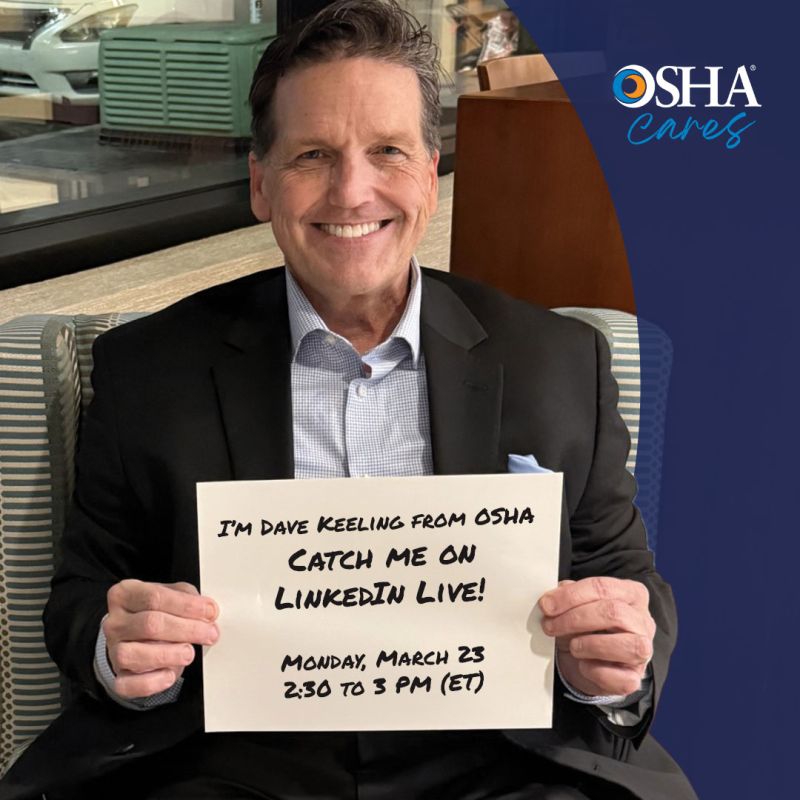
It did not start off well. OSHA couldn’t link in to LinkedIn, so they zoomed over to Zoom, which you only knew about it you tried to sign into LinkedIn and found the new Zoom link in the comments.
After twenty minutes, it finally started. And went rapidly down hill.
Now don’t get me wrong. I haven’t met Dave in person, but I’ve seen him in some podcasts and he strikes me as a very nice guy, and probably very sincere.
But I’ve never in my life heard so many meaningless platitudes and so little real substance packed into slightly less than an hour.
I had heard he liked golf metaphors and he did not disappoint. He started off assuring everyone that enforcement was still important, but that we had to “use all the clubs in the bag.” OSHA needs to talk to all sides and hear from labor, industry and professional societies…from everyone. But it was important for OSHA to reclaim leadership in the field of workplace safety and health because “OSHA has taken a step back over last 15 years or so when it comes to leadership.”
He said that OSHA inspectors feel like they can’t engage unless there’s a standard. News to me and anyone (including OSHA inspectors) who have ever heard of the General Duty Clause.
He thinks that OSHA needs to get to workplaces before an injury or death occurs. True enough. But not exactly an original thought.
And like most Republican administrations, he seems to believe that the only way to be proactive is to do more Compliance Assistance — ignoring the much more effective deterrent effect of the realistic threat of strong enforcement and high penalties.
And he provided some tantalizing tastes of future new enforcement initiatives.
He said that he did not want to deemphasize enforcement, but rather to “use resources more effectively.” In his view, OSHA inspectors are “hemmed in on what they’re asked to do on worksites.” He wants to use social media to get the message use social media more effectively, especially in rural areas.
He wants to use A.I. more — like for translation, predictive analytics, and other purposes. He repeated several times that “We’re not afraid of A.I.” (which somehow made me a bit more afraid of A.I.)
He claimed the new poster was in response to inspectors’ claims that the old one was hard for workers to read. And he’s very excited about the QR code on the poster. (And it is certainly a very exciting QR code.)
When asked about what OSHA was going to do for small business concerns, he imagined a world where OSHA shows up at a small business and the small business owner opens the door and says “What took you so long?”
He thought maybe we should focus the Harwood program on small businesses (which it already does.)
But in the whole discussion about how to engage more effectively with small businesses, he failed to even mention OSHA’s small business Onsite Consultation Program. (Maybe he doesn’t know about it. His career was spent with UPS and Amazon, not exactly small businesses.)
And there was lot of other profound stuff like:
“We don’t need standard or citation to make things better.”
“When it comes to OSHA Cares and Safety Champions, that’s where we need to go: provide leadership in the industry that makes sense.”,
“We need common sense approaches that solve problems.”
“We want to be in the abatement business, in the support business, not just enforcement business.”
“That’s not to say we’re not going to hold bad actors accountable.”
“We want to give employers the opportunity to get in on the ground floor and engage with OSHA to make sure they’re doing things in the right way for the right reasons.”
“If employers won’t do the right thing for the right reasons, we have the right hand to lift people up, but there’s still a left hook…” (Clearly borrowing from Yasser Arafat’s famous quote: “I come bearing an olive branch in one hand, and the freedom fighter’s gun in the other. Do not let the olive branch fall from my hand.”)
And concluded that “We’re here to help employers do the right things for the right reasons.” (Personally, I’d even be happy if employers do the right thing for the wrong reasons…)
He also pointed out that out of the more than 5,000 workplace fatalities every year, OSHA only has jurisdiction over around 800 of those. I’m not sure about the accuracy of those statistics (that number seems a bit low), but there are clearly many areas where OSHA does not investigate fatalities: Over-the-road truckers, public employees in 23 states, self-employed workers, workers on small farms, workplaces exempted from OSHA jurisdiction because other government agency allegedly take care of worker safety, and many workplace violence fatalities that OSHA allows law enforcement agencies to address. (Some of these are legal constrictions, some are choice.)
He’s right that there’s more OSHA can do in a lot of those areas — if the agency wasn’t starved for resources.
(Note: I’m a pretty fast and accurate typist, but the quotes above may nevertheless not be 100% word-for-word accurate.)
Conclusion
So, what can I say? Pretty much all we’re seeing so far are a new website and poster (with a QR code!!) and a bunch of meaningless, but nice sounding words. (But good to know they’re not afraid of A.I.)
Keeling tantalized the crowd with hints of new programs and changes to come. From the clues he dropped, I’d wager that the new program will consist of directing inspectors to also do some compliance assistance while they’re at a site. (Inspectors already help employers figure out how to abate hazards, plus OSHA already have Compliance Assistance Specialists in Area Offices — as well as the Onsite Consultation Program — that do that.)
We saw in the Bush years how OSHA focused on making VPP the future of OSHA, only to realize that the planned expansion of the program was siphoning resources from enforcement while the integrity of VPP deteriorated drastically.
Will Keeling fail to learn from history and repeat the same mistakes?
I’ll admit that I don’t have a whole lot of confidence. Even if Keeling means well, he’s working in an administration that this year proposed to cut OSHA’s tiny budget by 8% — slashing the standards budget by 24% and the enforcement budget by almost 10%. And Trump yet again proposed to kill the Susan Harwood program. They mostly weren’t success in these efforts, but it doesn’t give you warm feelings that OSHA really cares.
We shall see.
Watch this space.
the number of 800 sounds low, but it may be the number of fatalities investigated by federal OSHA. i think the number opened was 1000-1100 a year when i was there and was on track to dip under 1000 in 2024. some of those end up out of scope. the states conduct a similar number (i believe the state numbers may actually be higher due to broader exercise of jurisdiction for public employees and more farm workers). some of that is subject to an initial decision to investigate, which can vary, such as when applying the investigation policy to a death from workplace violence.