
Welcome to Groundhog Day 2027.
Last year, Donald Trump, that shell of a man living in the soon-to-be half demolished white house over at 1600 Pennsylvania Avenue, proposed a disastrous budget for the agencies that Congress created to protect workers from death, illness and injury in the workplace. Happily, Congress told him to go to hell.
But that defeat did nothing to soften Trump’s hostility toward the working people of this country. This year, apparently not taking the hint, Donald Trump, that shell of a man living in the half demolished white house over at 1600 Pennsylvania Avenue, proposed an even more disastrous budget for the agencies that Congress created to protect workers from death, illness and injury in the workplace.
And Congress will again, inevitably, tell the President to go to hell. Only this time, before we have a final FY 2027 budget, there will likely be a House of Representatives controlled by Democrats — and possibly even a Senate controlled by Democrats, or at least a smaller Republican majority.
This year, like last, the President has proposed steep cuts in OSHA enforcement and standards development. He is proposing to suck money and staff time directly out of OSHA’s main job, enforcing the law, into compliance assistance for employers. And he has again proposed to cut NIOSH and eliminate the Susan Harwood Worker Training Grant Program and the Chemical Safety Board.
And as a rotten cherry on top of this festering cake, the White House also decided that civilian federal employees don’t need any raise in 2027 — despite the rising prices caused by his tariffs and wars. Trump did, however, propose a 7% pay raise for members of the military.
The good news is that Presidents often hear Congressional leaders telling him that his budget is “dead on arrival.” This one died long before it arrived.
OSHA Budget
As I’ve often said, if budgets are the monetary expression of an organization’s values, Trump’s message to workers last year was: Drop Dead. Trumps message this year is: Drop Dead. Only do it faster please.
Enforcement
OSHA’s main job is to save lives and prevent work-related injuries and illnesses by enforcing the law: using inspections and penalties to ensure that employers comply with OSHA standards and regulations in order to reduce the killing and maiming of workers in this country. More than 380 workers are killed from traumatic injuries and workplace illnesses every day in this country, and more than 8,600 suffer injury and illness each day because of dangerous working conditions. And most of those deaths, injuries and illnesses are preventable.
OSHA has been given a huge mandate, assuring the safety and health of 158 million workers at more than 11.5 million workplaces. But because of OSHA’s paltry budget, however, it would take the federal OSHA 191 years to inspect every workplace in the country under its jurisdiction just once. (Just to put that in perspective, 191 years ago the President of the United States was Andrew Jackson.)
The American people spend a paltry $3.85 a year to protect each worker that the agency is responsible for.
Despite the clear need for drastic increases in OSHA’s budget, the President is once again proposing a draconian cut in OSHA’s enforcement spending — a decrease even deeper than last year’s proposal. And some of those enforcement cuts will be directly transferred to the compliance assistance budget.
Republicans tend to argue that enforcement is “confrontational” and that most employer want to do the right thing, so OSHA mainly needs to use more voluntary cooperative compliance assistance initiatives and less confrontational enforcement and everything will be fine.
But as some labor wag once remarked. “Voluntary programs are great. But what if everyone doesn’t volunteer?”
Promoting safety or requiring safety?
The enforcement section of the President’s OSHA budget starts out assuring workers that “The requested funding supports the promotion of safe working conditions.”
Good to know. Except that OSHA’s purpose is not to just “promote” safe working conditions. The Occupational Safety and Health Act of 1970 stated that the purpose of the law is to “assure safe and healthful working conditions for working men and women; by authorizing enforcement of the standards developed under the Act.”
In other words, not just act like an advertising agency that promotes safe working conditions, but actually enforcing the law.
Trump’s budget, unfortunately, doesn’t come close to being adequate to enforcing the law. Trump is proposing to slash the federal OSHA enforcement budget by 15.1% — from $243 million to $210.3 million. This is even worse than last year’s proposed 9.7% proposed cut.
Enforcement staff is already at the lowest level in OSHA’s 55 year history.
What this obviously translates into is fewer inspections. In FY 2025 (October 1, 2024- September 30. 2025) OSHA conducted 30,283 inspections, around 4,400 fewer than FY 2024, the last full year of the Biden administration.
We don’t know yet what the FY 2026 inspection numbers will be, although early data showed a significant decrease. Trump is proposing only 22,040 inspections for FY 2027, 8,243 (27%) fewer inspections than the agency conducted in FY 2025, and 12,642 (36%) fewer inspections than in FY 2024, the last full year of the Biden Administration.
With the exception of two COVID years, this would the lowest number of inspections in OSHA’s history. Even in the 1980s, at the height of the Reagan administration, OSHA averaged over 60,000 inspections per year. And there were many fewer workplaces and workers back in the 1980s.
With the exception of two COVID years, this would the lowest number of inspections in OSHA’s history. Even in the 1980s, at the height of the Reagan administration, OSHA averaged over 60,000 inspections per year. And there were many fewer workplaces and workers back in the 1980s.
Fewer inspections means less law and order in the workplace. The shrinking of OSHA inspections is no secret. Employers who are inclined to cut corners on workplace safety and health will know that they will be even less likely to see an OSHA inspector than ever before. Deterrence will weaken and more workers will likely get injured, sick and killed as a result.
Another troubling element in this year’s budget is OSHA’s plan to “commit resources to worksite assistance during inspections to assist employers, particularly small businesses, in creating safer workplaces.” (see below.) This is troubling, not because the main job of inspectors is to enforce the law. We’re not sure what this new proposal will mean, but it appears that OSHA’s record low number of inspectors will also be expected to devote much more time to compliance assistance activities instead of enforcement.
Compliance Assistance
Trump proposes to cannibalize OSHA enforcement to give OSHA’s compliance assistance programs a huge increase next year. If Trump has his way, OSHA’s compliance assistance services for employers can expect to see a budget increase of $11.1 million and 60 additional employees. That’s a 14% increase to match the 15% cut from enforcement. Most of that increase in compliance assistance — $7.3 million and 29 employees — will be transferred directly out of OSHA’s enforcement program.
The budget justifies this misuse of OSHA funding by arguing that:
These program increases reflect OSHA’s commitment to meeting employers where they are – whether they are just starting their safety journey or longtime leaders in their industry—and providing them tools, resources, and recognition for success at every step….Shifting 39 FTEs from enforcement to compliance assistance demonstrates OSHA’s commitment to ensuring that enforcement is consistently balanced by meaningful efforts to help employers understand how to achieve compliance and implement or strengthen their workplace safety and health programs. [emphasis added]
The 39 addition FTEs (or Full Time Equivalents) will not be actual bodies, but more time spent by each OSHA inspector conducting compliance assistance work, instead of the job they were hired to do: enforcing the law. And, of course, some of this compliance assistance increase will go toward increasing participation in OSHA’s troubled Voluntary Protection Programs.
The budget also proposes adding 21 new federal Compliance Assistance Specialists (CAS) who will “significantly strengthen the agency’s ability to conduct proactive outreach to small businesses and employers in high-hazard industries and respond to emerging hazards.”
Now I don’t have a major objection to CASs. They provide a useful function and if used properly, cannot only help employers understand how to comply with OSHA standards, but also reach out to immigrants and other hard-to-reach workers in dangerous jobs. At one point, OSHA had one CAS in each of OSHA’s 70 area offices and they took some of the burden off of OSHA inspectors allowing them to spend all their time on enforcement.
But there are several problems with the large compliance assistance budgets that Trump is proposing. First, as I’ve written before, most employers don’t really need that much compliance assistance help from OSHA.
Workers have few resources to get the information they need — especially those workers who don’t belong to unions — which, sadly, comes to around 90% of workers in the country. Workers may not be aware of the hazards they’re facing in the workplace, how the OSHAct works, their rights or the tools they can use to force their employers to provide a safe workplace.
Employers, on the other hand, have many ways to get training and information. And things have gotten much better for employers who need information. In addition to the organizations I listed above, employers can hire full time safety and health staff or consultants. Small employers who may not be able to afford staff or consultants, can take advantage of the Onsite Consultation program which OSHA funds in every state and provides free assistance and non-enforcement inspections (consultations) to small- and medium-size employers.
Second, Republicans always like to think that only compliance assistance — and not enforcement — is “proactive,” while enforcement is somehow only reactive — as if OSHA issues citations only after a worker is hurt or killed. They neglect strong evidence that enforcement that OSHA inspections and enforcement don’t just punish employers after workers are injured or killed, but actually prevent injuries before they happen. According to researchers David I. Levine and Michael W. Toffel, OSHA’s random inspections of high hazard establishments result in a 9% reduction in injuries that triggered workers’ compensation claims in the four years following the inspection.
Meanwhile, despite Republicans obsession with OSHA’s alleged oppression of small businesses, the State Compliance Assistance budget — the program that provides 90% of funding states need to run their On-Site Consultation Program (free services for small and medium size businesses) — will remain flat next year, although somehow OSHA expects that number of onsite consultations to increase.
The old doing-more-with-less myth lives on.
Susan Harwood Grants
While Trump proposes to pump up assistance to employers from $78.3 million to $89.4 million, he is once again proposing to eliminate the only compliance assistance program that benefits workers: the tiny $12.8 million Susan Harwood Worker Training Grant program.
This, again, is no surprise, considering that every Republican President since George W. Bush — and every House of Representatives under Republican control — have proposed eliminating the program which dates back to OSHA’s New Directions grants created in 1978 during the Carter administration. Fortunately, the Republican hit squad has been unsuccessful, so far. You can read more about the grants program and their defense from previous attacks here.
The Harwood grants are the only OSHA program that provides hands-on training to workers. Grants were awarded to unions, COSH and other worker groups, small business associations, colleges and universities. The true value of the Harwood program is that it is able to provide effective training to vulnerable workers and others who OSHA inspectors and compliance assistance staff can not otherwise reach: those whose first language is not English, day laborers, low income workers, temporary employees — and others in high hazard industries. One thing we found at OSHA was that many of the most vulnerable workers are uncomfortable talking to OSHA inspectors, or don’t even know that OSHA exists or how it works. By providing grants to groups that had direct contact with vulnerable worker populations, the Harwood program significantly expanded OSHA’s reach and impact on the workers who need OSHA most.
More than 1.7 million workers have been trained under the Harwood program just since 2001. Over the 40 years the grant program has been in existence, the total amount has never gone far over $14 million. You can find publications developed by grant recipients here.
Harwood grants have always been available to non-profits: unions, COSH groups, industry associations, colleges and universities. But last September, the Trump administration announced that it would be confining grants to OSHA State Programs, OSHA On-site Consultation Programs, and OSHA-authorized OTI Education Centers only.
What’s Trump’s reasoning for killing the program this time around?
The FY 2027 budget repeats last year’s criticism of the Harwood program as “wasteful and unnecessary given there is limited evidence of success and the agency has other compliance assistance programs and tools that are more effective than Harwood Grants.”
The facts, however, show that it has been highly successful and effective in protecting the lives of this country’s most vulnerable workers. Some of its success stories can still be found here (at least for now.) And no other OSHA programs — Alliances, Strategic Partnerships, On-site Consultation, etc. — provide the kind of direct training to workers, nor do they produce the kind of publicly available worker-oriented training materials that the Harwood grant program provides.
OSHA has never produced any actual evidence — even when under Republican control — that Harwood Grant spending is “wasteful.” But maybe that’s not the real reason anyway. The White House budget summary may better explain the real reason that they want to eliminate the program: ideology.
According to the White House,
The Budget proposes to eliminate OSHA’s Susan Harwood Training Grants, which under previous administrations:
-
- Were weaponized to fund questionable activities such as “workers’ rights training,” for migrant farmworkers, as opposed to occupational safety training; and
- Funded woke organizations like the National Day Laborer Organizing Network, Farmworker Justice, Laborers International Union of North America, Asian Immigrant Women Advocates, Brazilian Worker Center Inc., Legal Aid Justice Center, and Latino Worker Safety Center.
Well at least they’re being more honest about their hostility toward workers. We wouldn’t want any migrant farmworkers to know their health and safety rights, would we? And of course, any organization that supports day laborers, farmworkers, Asian women, Brazilians or Latinos must be “woke,” and filled with probably illegal brown-skinned people who apparently don’t have a right to live until the end of the workday. Even the Laborers union, one of the oldest and largest unions in the country, is listed here as a “woke” organization. Probably because the pinheads at the White House assume that any organization with the word “laborer” automatically means “Latino” which automatically means illegal.
Any organization that supports day laborers, farmworkers, Asian women, Brazilians or Latinos must be “woke,” and filled with probably illegal brown-skinned people who apparently don’t have a right to live until the end of the workday.
Just a word of explanation for any Trump fans who may be reading this. Much of the allegedly “weaponized” funding went to organizations originally funded during the Obama administration because Latino and other immigrant workers have a higher fatality rate than non-Latinos (In 2024, the Latino fatality rate was 4.3 per 100,000 workers, compared with an overall worker fatality rate of 3.3. Also in 2024, 68.5% of Latino workers who died on the job were immigrant workers.)
OSHA had too few inspectors who spoke Spanish (or any other foreign language) and immigrant workers not only didn’t understand their rights under the law, but were often afraid to talk to government officials because of bad interactions with government officials in their home countries. And the “woke” organizations that OSHA funded (some of which are condemned above) could reach Latino and other immigrant workers much more effectively than OSHA inspectors could.
But apparently, according to the current regime, all of that is apparently “woke” and “weaponization.” But the Harwood program isn’t the only federal program that DOGE apparently failed to root out for its wokeness. The word “woke” is used 34 times in this document as an excuse to cut various federal programs.
The bottom line is that, at less than $13 million, the Harwood program is barely a tiny speck in the federal budget and an incredibly efficient and effective way to reach the most vulnerable workers. The only feasible reason for its elimination is that it’s been extremely effective in empowering workers to defend their right to a safe workplace. And that threatens the business community.
Standards and Guidance
The biggest proposed percentage cut in OSHA’s budget (aside from elimination of the Harwood Grants) is the 15.1% cut from the standards budget. OSHA is only requesting funding to support 44 staff, 4 less than it proposed last year and a decrease of 23 from FY 2025 — almost one-third of the directorate’s current staff. (Just for reference, in FY 2012, standards was budgeted for 96 staff). This number will allegedly allow OSHA “to meet the President’s goals as expressed through the regulatory agenda.” (Although we haven’t seen a regulatory agenda since Spring 2025.)
Given the hostility in this administration (and in the Republican party) toward regulations in general, the severe cuts to OSHA’s regulatory office is hardly surprising. No Republican administration since George H.W. Bush has issued a single major OSHA standard (aside from those ordered by the courts.)
Given the hostility in this administration (and in the Republican party) toward regulations in general, the severe cuts to OSHA’s regulatory office is hardly surprising. No Republican administration since George H.W. Bush has issued a single major OSHA standard (aside from those ordered by the courts.)
But by proposing these cuts, they’re also undermining their own agenda. Trump’s OSHA is has an active deregulatory agenda and eliminating standards and regulations takes almost as much time and resources as issuing new standards and regulations. Trump’s OSHA has also not decided yet what it wants to do with the heat standard. Industry representatives who testified last year pressed OSHA to do nothing, or to go back to the drawing board and issue a standard that would be much weaker than the Biden’ administration’s proposal. But doing a major revamp of the Biden proposal and issuing a final standard before the end of the Trump administration would require a large amount of resources that OSHA isn’t requesting.
Although we have yet to see the Fall 2025 Regulatory Agenda, the Spring 2025 Regulatory agenda had OSHA still working on standards such as heat, emergency response workers and tree care. But despite what’s on the regulatory agenda, they seem even less willing than last year to conduct any regulatory activity on any new standards. Last year’s line that “This funding will allow OSHA to continue….updating older OSHA standards and new rulemakings for high-hazard industries or processes” is missing from the current Congressional Budget Justification (CBJ).
The budget justification does say that they expect to issue three proposed rules and two final rules, but it doesn’t mention which ones they are — and given the agency’s lack of progress on anything significant, it is likely that these proposals and final rules are coving minor issues and updates. The only real “accomplishments” the budget mentions for FY 2027 are “a library of resources and tools for developing safety and health programs” (whatever that is) and twenty “guidance documents.” These could be anything from a major publication to a short fact sheet.
State Plans
OSHA funds 50% of the 29 state plan programs (21 states plus Puerto Rico run full programs, and 6 states plus the Virgin Islands run public employee only programs.) The state plans run their own OSHA programs: developing standards (copying OSHA’s or developing their own), and conducting enforcement operations, whistleblower investigations, and compliance assistance for over 40 percent of the country. The budget documents acknowledge that “it is imperative that OSHA State Plans have sufficient funding to continue their operations in protecting the health and safety of American workers.”
So one might wonder why the Administration then turns around and chops $4.8 million (4%) off the state plan budget. Only 36,323 inspections are planned in the state plan states next year, a 6% decrease from the 38,642 state inspections conducted in FY 2025.
Whistleblower Program
OSHA currently administers and enforces whistleblower protection provisions of 25 different statutes, including Section 11(c) of the Occupational Safety and Health Act of 1970. The program has been perennially underfunded and too slow to respond to whistleblower complaints, although its operation has improved significantly in recent years. The Trump administration is proposing a major change in this program’s mandate, moving all whistleblower enforcement except 11(c) health and safety cases to a newly formed DOL Office of Civil Rights. OSHA’s whistleblower budget would be reduced by 25%, and 38 of the Office’s 76 employees would be cut or moved over to the new Civil Rights office. In the early years of the Obama Administration, OSHA toyed with the idea of moving all non-OSHA whistleblower complaints out of OSHA, but the idea attracted little Congressional support.
Statistics
One of the few budget line items that will see a significant increase is OSHA statistics which will grow by $5 million and 5 employees. Most of this increase seems to be dedicated to using A.I. and other measures to modernize OSHA’s data systems, digest the mountains of information that OSHA collects through its recordkeeping and severe injury reporting requirements and better set OSHA priorities. I’m not a data expert, but I remember one of our biggest frustrations during the Obama administration was the antiquity of OSHA’s data systems and the inability to actually analyze much of the data to inform OSHA strategic initiatives. So if they can make more data available to the public, researchers and OSHA policy staff, I’m all for it.
Of course, data can be used for good as well as evil, so we’ll see how this develops. For example, some of this effort will be dedicated to “improved voluntary engagement through programs such as the Voluntary Protection Programs (VPP).” I have no idea what that means, but anything that promotes the growth of “voluntary” programs is suspicious, given OSHA’s lack of enforcement and regulatory resources.
Technical Support
OSHA admits that “Technical Support is a critical component of the agency’s enforcement and compliance assistance efforts.” So critical that OSHA’s technical support budget is taking a heavy 13.5% hit in Trump’s budget proposal, losing 8% if its staff. Under this budget item, OSHA assists inspections by identifying, sampling, and analyzing hazardous substances, investigating workplace hazards, developing control strategies, and producing technical publications and products. OSHA’s technical support office also provides information and support for emergency management and response during catastrophes — especially “new” catastrophes like the Deepwater Horizon oil disaster in 2012, hurricanes, H1N1 flu, the Zika virus and COVID-19. Most of the “savings” seem to be a reduction in “technical equipment procurement, servicing, and training resource requirements by standardizing the technical support equipment and utilizing a new data-driven and scalable procurement plan to more efficiently manage OSHA’s equipment inventory.” Sounds like they’re once again recycling the old “doing more with less” myth to me. But we shall see.
Advisory Committees
Contrary to the myth that OSHA staff sits in their dark offices, making up rules that have no relation to the real world, OSHA once had a number of Advisory Committees: Construction, Federal Employees, Maritime Employees, Whistleblower as well as the umbrella National Advisory Committee on Occupational Safety and Health. The committees were mandated to have labor, management and public members and met publicly several times a year. These advisory committees met publicly several times a year to advise OSHA leadership on issues that they should be working on, what was working, what wasn’t working well and how OSHA standards and emphasis programs should be structured.
But Trump’s OSHA has decided that it doesn’t need no stinking advice from anyone on the outside (at least advice in a form that is open to the public) and will only continue to meet with the construction advisory committee — the only committee mandated by law. “All other Advisory Committees are not required by statute and have been paused indefinitely.”
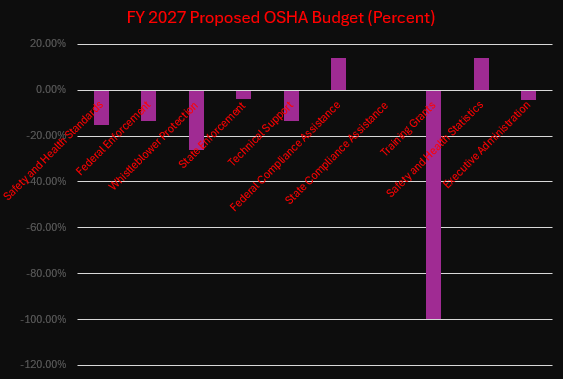
FY 2027 President's Proposed OSHA Budget (Thousands of Dollars)
| FY 2025 Final | FY 2026 Final | FY 2027 Request | Dollar Change From 2026 Final | Percent Change From FY 2026 | |
|---|---|---|---|---|---|
| TOTAL | 632,309 | 629,309 | 582,381 | -46,928 | -7.5% |
| Safety and Health Standards | 21,000 | 18,500 | 15,700 | -2,800 | -15.1% |
| Federal Enforcement | 243,000 | 243,000 | 210,078 | -32,922 | -13.5% |
| Whistleblower Protection | 26,000 | 22,500 | 16,667 | -5,833 | -25.9% |
| State Enforcement | 116,673 | 120,000 | 115,200 | -4,800 | -4.0% |
| Technical Support | 26,000 | 26,000 | 22,500 | -3,500 | -13.5% |
| Federal Compliance Assistance | 79,973 | 78,262 | 89,376 | 11,114 | 14.2% |
| State Compliance Assistance | 61,276 | 63,160 | 63,160 | 0 | 0.0% |
| Training Grants | 12,787 | 12,787 | - | -12,787 | -100.0% |
| Safety and Health Statistics | 35,500 | 35,500 | 40,500 | 5,000 | 14.1% |
| Executive Administration | 10,100 | 9,600 | 9,200 | -400 | -4.2% |
NIOSH
As we all know, the National Institute for Occupational Safety and Health (NIOSH) has had a hell of a year. Elon Musk’s DOGE attempted to destroy the entire agency and move any remaining remnants out of CDC to the newly established Administration for a Healthy America (AHA), creating havoc throughout the country. Happily, a massive public outcry and court action brought most of NIOSH back to life — especially those parts that dealt with black lung disease and other mineworker hazards, respirator certification and other offices crucial to workplace safety. Then Congress restored NIOSH’s entire budget in the FY 2026 budget.
But this administration’s hostility toward workers and this vital worker protection agency never seems to cool. NIOSH is now apparently back within CDC, not moving the AHA as was announced last year, but it will be folded into a new entity within CDC: The National Center for Chemicals and Toxins (even though NIOSH does much more than just address the problems of chemicals and toxins.)
FY 2027 President's Proposed NIOSH Budget (Thousands of Dollars)
| NIOSH (Thousand of Dollars) | FY 2026 Final | FY 2027 Request | Dollar Change From FY 2026 | Percent Change From FY 2026 |
|---|---|---|---|---|
| National Occupational Research Agenda (NORA) | 120,500 | 0 | -120,500 | -100% |
| Education and Research Centers | 32,000 | 0 | -32,000 | -100% |
| Personal Protective Technology | 23,000 | 16,000 | -7,000 | -30.4% |
| Mining Research | 68,500 | 68,500 | 0 | 0% |
| Other Occupational Safety and Health Research | 115,000 | 0 | -115,000 | -100% |
| National Mesothelioma Registry and Tissue Bank | 1,200 | 1,200 | 0 | 0% |
| Firefighter Cancer Registry | 6,500 | 6,500 | 0 | 0% |
| TOTAL | 366,800 | 92,200 | -274,600 | -74.9% |
Chemical Safety Board
The President’s budget once again proposes to eliminate the Chemical Safety and Hazard Investigation Board — as it has unsuccessfully proposed ever since Trump’s first term. Why? No one really knows.
What they say is that “as part of the Administration’s plans to move the Nation towards fiscal responsibility and to redefine the proper role of the Federal Government.” (a “role” which according to Trump, is not much more than waging war — on other countries and this country’s immigrants.)
According to the Trump budget
CSB duplicates more than adequate capabilities in the Environmental Protection Agency and Occupational Safety and Health Administration to investigate chemical related mishaps. CSB generates unprompted studies of the chemical industry and proposes regulations they have no authority to create or enforce. This function should reside within agencies that have the authorities to issue regulations in accordance with applicable legal standards.
What the President again misses is that the CSB is valuable precisely because they have no authority to create regulations or enforce them. Regulations and various laws tend to handcuff OSHA and the EPA. With some exceptions (like the difficult-to-use General Duty Clause), they are unable to cite employers unless they are in violation of their specific standards and regulations. The investigations that OSHA and EPA conduct pretty much stick to the specific regulations that are violated, rather than the root causes of incidents that may not be covered in a regulation or standard.
This tiny agency performs a unique (and at $14 million per year, inexpensive) function that no other Federal agency performs. Because the CSB is not tied to any specific enforceable laws or regulations, it can explore the interrelationship of federal regulations, state laws and industry standards to develop a comprehensive picture of the root causes of chemical safety problems and their solutions, and issue recommendations. The CSB can also address issues that are not covered by OSHA or EPA regs — things like understaffing, fatigue, changes in management and disinvestment in safety programs.
And while the CSB is not an enforcement agency and cannot issue citations, its recommendations to federal and state government agencies (like OSHA and EPA), industry associations (like the American Petroleum Institute) and labor unions can form the basis of changes in regulations and industry consensus standards. Many of the CSB’s recommendations have formed the basis of the Biden Administration’s revision of EPA’s revised Risk Management Program regulations (which the Trump administration is in the process of weakening) and OSHA’s (moribund) work on revising its 30 year-old Process Safety Management standard.
Getting rid of the CSB because EPA and OSHA can issue regulations and enforce the law would be like eliminating the National Transportation and Safety Board (NTSB) because the FAA has authority to issue rules and regulations governing transportation safety.
Trump’s continuing obsession with eliminating the CSB is even more puzzling as the agency has always received significant support from much of the chemical industry (especially the smaller players), as well as labor unions, public health advocates, as well as many Republicans in Congress who generally tend to oppose blowing up their constituents.
You can read much more about past activities and battles to save the CSB here.
What is to be done?
We are just at the beginning of the long appropriations process. There will be hearings and deliberations in the House and the Senate, and eventually both Houses of Congress will have to come up with a budget that they agree on. Judging from recent past history, the initial budget proposal from the Republican-controlled House of Representatives will likely be as bad as (or worse than) the President’s recommendations. The Senate, required to compromise, is likely to end up recommending the same budget as last year, which will hopefully prevail.
This year will be different than last year however. Congress has never in recent memory been able to complete a budget by the end of the fiscal year, September 30. This year is unlikely to be an exception. In fact, it is unlikely that Congress will be able to pass a budget before the November mid-term elections. In the likely event that the Democrats take back the House of Representatives, we could end up with a House appropriations bill that significantly improves over last year. In the unlikely (but possible) event that the Democrats also take back the majority in the Senate, it could be a whole new story — and a massive fight with the White House.
Of course budget issues will ultimately be fought over much bigger issues than workplace health and safety: things like massive increase Trump is requesting for the Department of War Defense
This where you come in.
We saw last year how public and media pressure helped restore NIOSH, and eliminate the proposed cuts in OSHA and MSHA.
Your Senators and Congresspersons will need to understand that cuts in OSHA, MSHA, NIOSH and the Chemical Safety Board will mean that more workers — their constituents — will get killed, maimed and sickened. They need to hear real stories of how these agencies save lives.
Even Representatives and Senators who are friendly to workplace safety and health need to hear from you so that they know what to prioritize when faced with requests to support a million different issues.
And if you live in a district or state with members on the Appropriations Committees, your voice is especially important.
More details on strategy will emerge from unions and public health advocates during the coming Workers Memorial Day and over the following months. Watch this space.
(Note: Trump is also proposing major cuts and reorganization in the Mine Safety and Health Administration. I’ll write about that later.)