
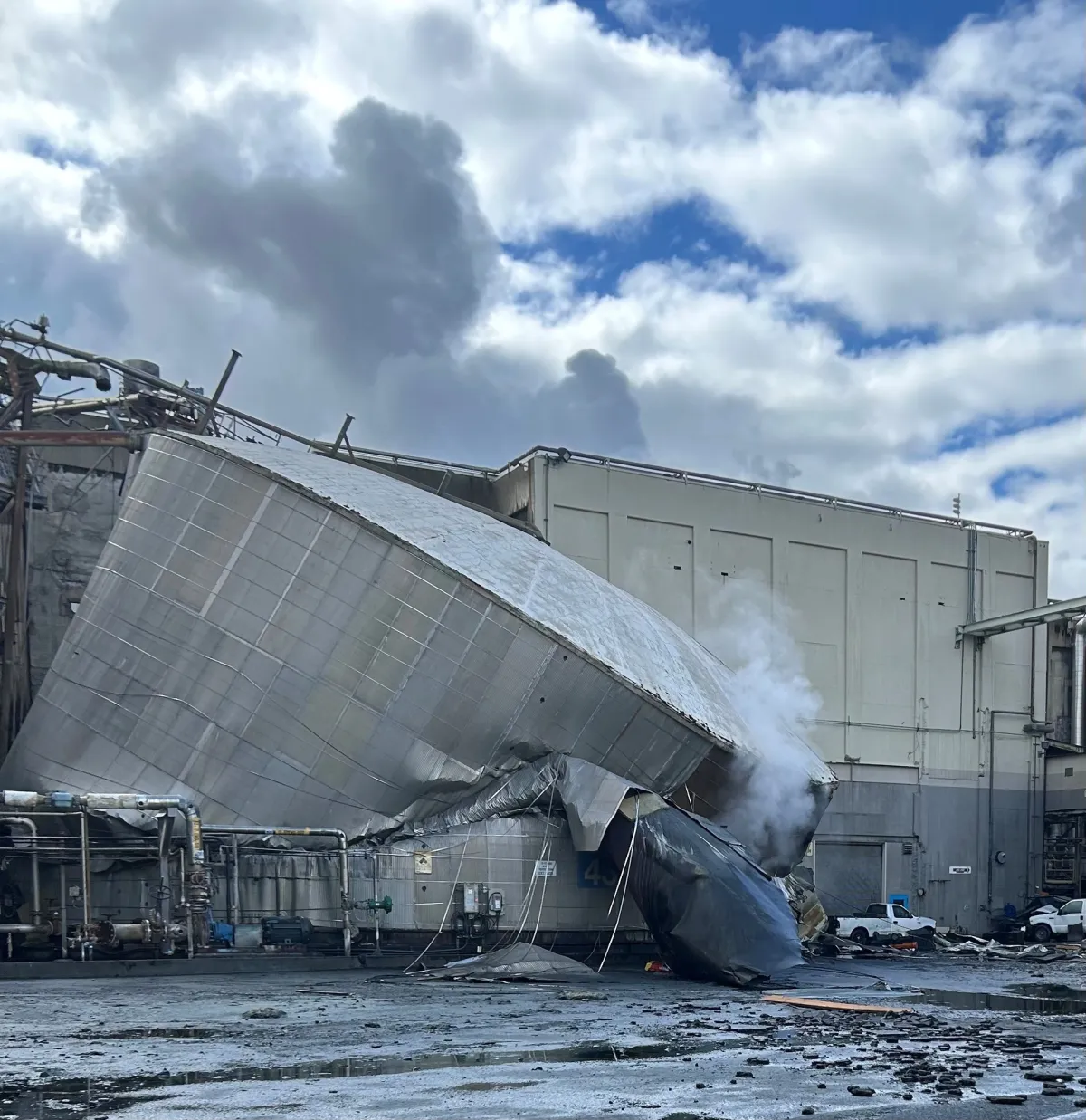
At least eight workers are now confirmed dead, and firefighters believe there are three more bodies they have yet to reach after a 900,000-gallon caustic chemical tank imploded on Tuesday at the Nippon Dynawave paper plant in Longview, Washington. The tank contained “white liquor,” a caustic chemical mixture of sodium hydroxide, sodium sulfide and sodium carbonate, which is used to break down wood chips into pulp. All but 25,000 gallons was released from the tank.
Around 550 people work at the Nippon Dynawave facility. The tank rupture happened during the early morning shift change, so there were more workers than usual at the site.
Washington Gov. Bob Ferguson described the incident as the “deadliest industrial tragedy in modern Washington state history.”
Washington is no stranger to workplace disasters. Most recently, seven worker died at the Tesero refinery explosion in Anacortes in 2010, and in 1998, six workers died in the Equilon Refinery fire in Anacortes.
The catastrophe is the biggest workplace disaster in the United States since 16 workers were killed in a 2025 blast at the Accurate Energetic Systems plant in Tennessee.
What Does the Plant Do?
The process pulping process is hazardous:
This chemical process itself is called kraft pulping, and it’s been in use for well over a century, said Julia Shamshina, an associate professor at Texas Tech University focused on fiber and biopolymer research. It’s the dominant practice worldwide in the paper and pulp industries.
At the outset, mixing dangerous chemicals with high temperatures and pressure can amount to a recipe for disaster under the right conditions, Shamshina said.
“If there is any way for an accident to happen, it will,” she said.
In simple terms this process requires a mill to place wood chips into a large tank filled with a slurry of caustic chemicals — sodium hydroxide and sodium sulfides (called “white liquor”) — where it’s cooked under pressure to break down the material.
The second risk point comes after the mixture is cooked and the mill attempts to recover its own chemicals from the mixture, which is now called “black liquor.” A byproduct of this process, called “molten smelt,” is particularly dangerous, Shamshina said, because it can cause an explosion if it comes into contact with water.
Why Did the Tank Implode?
Although it is not yet known what caused the implosion, Shamshina has some ideas:
Speaking in general terms, a tank of that size could have been for storage rather than a more active part of the process, said Robin Rogers, a professor emeritus in the department of chemistry and biochemistry at the University of Alabama, Tuscaloosa.
Large temperature swings in the tank could potentially lead to an implosion, Rogers said. If crews attempted to remove quantities of the white liquor without a supply of air or anything else to replace the volume, that could lead to an implosion as well.
All these hazards and more are well known and can be managed, Shamshina wrote in an email, “but when maintenance, inspection, training, or safety systems fail, the consequences can be serious.”
Severe Injuries
Workers who survived the blast suffered extremely severe wounds, according to Dr. Mark Thomas, associate director of the burn center, housed at Legacy Emanuel Medical Center in northeast Portland:
A caustic chemical used to break down wood into pulp, white liquor is like “really concentrated bleach,” Thomas said. Exposure is especially concerning because of how deep it can seep into the body, he said.
“We always think about acid (burns) being the worst,” Thomas said. “Alkaline substances are worse.”
He continued, “Not only do you get skin involvement, but you get the underlying fat tissue, what we call adipose tissue, down into the muscle and even into bone.”
Thomas has treated patients with similar chemical burns, but “nowhere near the extent that we encountered Tuesday,” he said.
Exposure to white liquor can also damage the eyes:
Dr. Barclay Stewart, a trauma, burn and critical care surgeon at UW Medicine, also pointed to concerns about eye injuries in instances of chemical exposure. Both the alkaline substances and fumes can lead to ulcerations on the cornea and ocular burns, said Stewart, associate chief of trauma and burns at Harborview Medical Center.
Major burn injuries are not conditions that can be “treated and done,” Stewart added. “It’s a chronic disease.”
But with treatment and rehabilitation, many patients do get better over time, he said.
Two of those injured in the implosion continue to receive care at the Oregon Burn Center, according to Legacy Health. Five have been discharged. “There’s some individuals who will be with us for an extended period of time,” Thomas said.
Some of the white liquor spilled into the Columbia River and some entered the nearby storm water drainage system. “Environmental regulators are not sure how much or where the rest went, though they have said there is no air quality risk and no risk to the local water supply.”
What is the Plant’s History
The Longview plant “carries a long history of clean air, water and safety violations, underscoring a system of problems at the facility and light responses from regulators,” according to the Seattle Times.
A sign outside the plant on Wednesday boasted of 100 straight “safe days” inside.
Discrepancy Report notes that state and federal regulators have assessed $41,500 in environmental penalties against the facility since 2017, including numerous violations from state environmental authorities including illegal wastewater discharges and Clean Air Act violations. Washington state Department of Labor and Industries has two ongoing health and safety inspections at the facility involving a sinkhole caused by a failed drain and a finger amputation. The plant has also received fall protection violations.
Longview is no stranger to paper plants:
Longview, 45 miles north of Portland, Ore., and about 120 miles south of Seattle, was founded as a company town by the timber baron R.A. Long during the logging boom of the early 20th century. R.A. Long High School maintains the Lumberjacks and Lumberjills as its mascots. Longview and Kelso next door are tight-knit, small communities. Many mill jobs are multigenerational. At least one of the people killed in the explosion, Gilbert Bernal, had a son who also worked at the plant.
A sign outside the plant on Wednesday boasted of 100 straight “safe days” inside.
Who Owns the Plant?
The plant, owned by the Nippon Dynawave Packaging Co., a subsidiary of the Japanese Nippon Paper Group, manufactures liquid packaging board. Nippon bought Weyerhaeuser’s Longview pulp and paper mill in 2016 for $285 million, and the site continues to be a major employer in the region. Nippon’s webpage boasts that “Our priorities are safety in all stages of the process, from the mill to delivery; reliability; consistency; continuous improvement; and top-notch customer service.” The website also contains a Environment, Society, Governance document that includes a sophisticated safety program. The company’s President, Matt Peerboom, is on the Board of the American Forest and Paper Association. Workers at the plant are represented by the The Association of Western Pulp and Paper Workers which was affiliated with the United Brotherhood of Carpenters and Joiners of America before they disaffiliated in 2023.
Who is Investigating?
The U.S. Environmental Protection Agency and the U.S. Coast Guard are investigating the incident. Washington Department of Labor and Industries Director Joel Sacks said Thursday that L&I, which includes Washington OSHA, will conduct a full investigation once emergency recovery operations have concluded. The Chemical Safety Board also announced Wednesday that it would investigate. National Guard members are also on site.
These catastrophes happen far too often with grave consequences yet the Trump Administration is again working to roll back Risk Management Program regulations intended to prevent these events. It is almost seems like the Trump Administration doesn’t care about worker (and community) health and safety….
Peter Dooley and I just spent a week at the USW Health Safety and Environment conference in Pittsburg. A USW brother in one of our workshops from another Pulp plant described the hazards there— he detailed how the “white liquor” was such a hazard and how the union was negotiating to get better protective clothing.
The loss of the workers at the Nippon Dynawave facility tells us all how much we need to be continuously identify and manage hazards with full commitment and without retaliation… I hate the word “ACCIDENT” — there’s always a cause.
Tolle Graham
National COSH Advisor
Retired: USW L.9358