
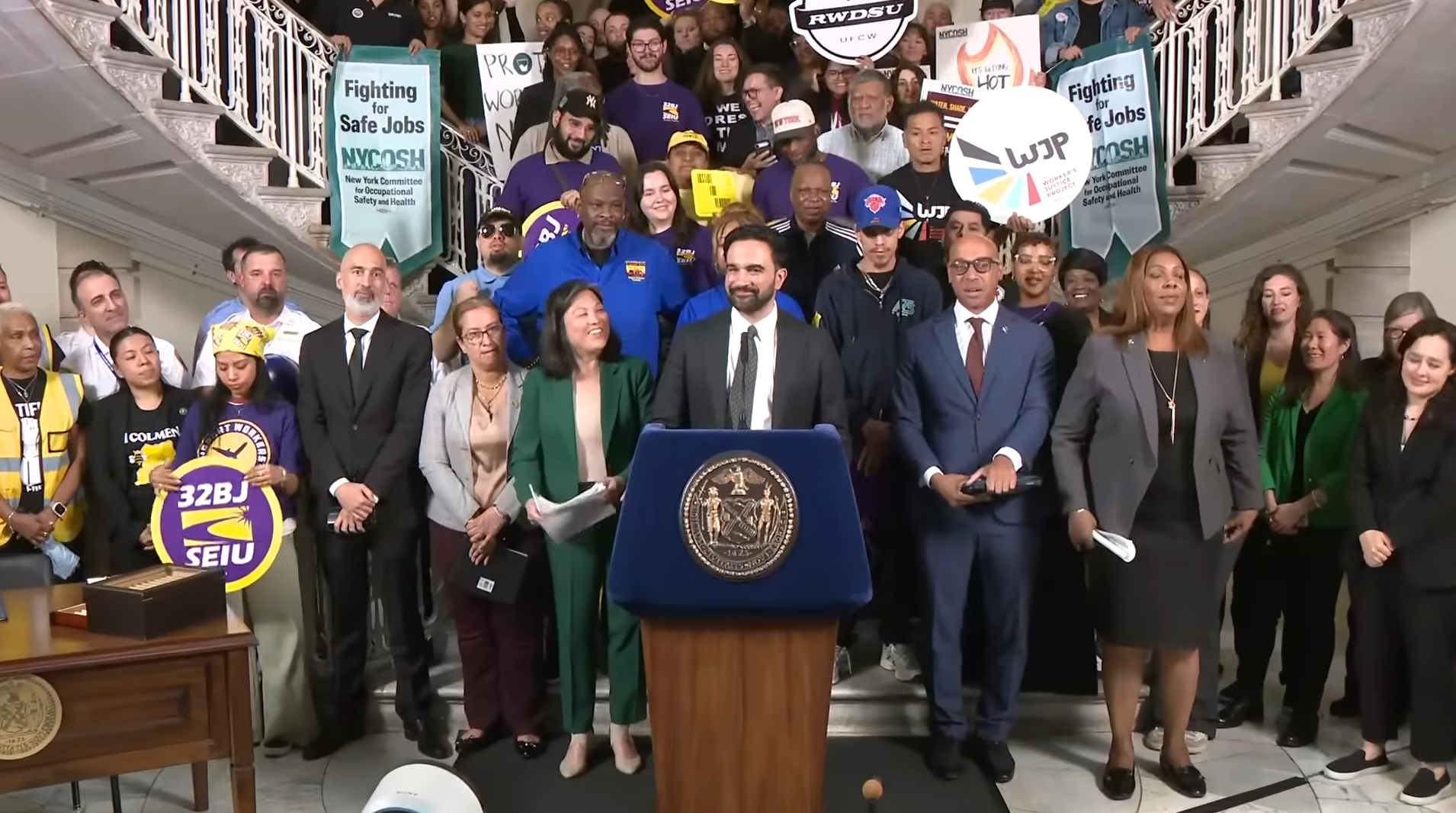
I happened to be in New York City last week visiting the kids and grandkids when I got an email announcing that Mayor Mamdani would issue an Executive Order to protect 1.4 million New Yorkers from heat hazards on Monday morning. So I headed down to the press conference at NY City Hall to see what was up.
Of course, what’s “up” theses days is temperatures and the number of workers suffering heat-related illnesses. What’s down is any federal activity to protect workers. The Trump administration can’t decide whether to kill or just critically weaken a strong OSHA heat standard proposed under the Biden administration. (My bet is on kill.) On the other hand, some states like California, Oregon, Washington and Maryland have issued strong standards, and Virginia is working on a standard.
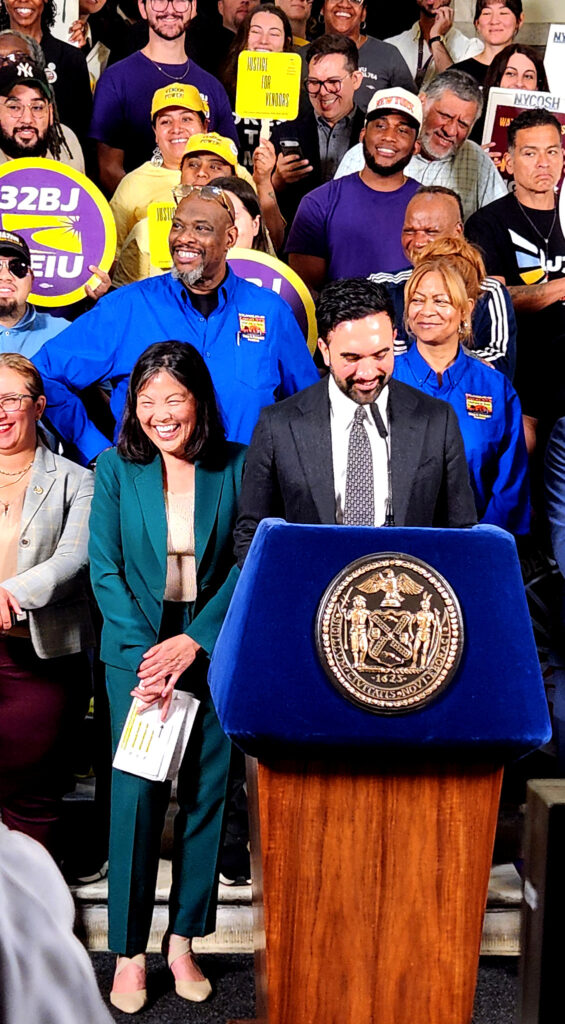
But led by Mamdani’s Deputy Mayor for Economic Justice, former Biden Acting Labor Secretary Julie Su, the Mayor — surrounded by dozens of New York union members and public health advocates — signed an Executive Order on Monday entitled “Protecting Workers from Extreme Heat.”
“No one should have to choose between their paycheck and their health,” said Mayor Zohran Kwame Mamdani. “The workers building our skyline, delivering our packages, selling food on our street corners and keeping this city running deserve to come home safe at the end of every shift. In the past, workers have borne the burden of extreme heat while government looked the other way. We’re changing that because every worker’s life is worth protecting. As summer heats up, we’re taking a whole-of-government approach to keeping New Yorkers prepared, safe and cool.”
Deputy Mayor Su added context:
For millions of working New Yorkers, heat isn’t just uncomfortable. It’s hazardous. Extreme heat kills more Americans every year than hurricanes, floods and tornadoes combined. And we know, because of climate change, it is only getting worse. The number of days above 90 degrees is projected to increase significantly in the years ahead. And despite all of this, extreme heat is still not recognized under federal law as a workplace hazard. No enforceable national standard, no guaranteed protections [and] workers on the clock in the heat with no clear legal right to shade, rest or water. Even though we know that those basic steps save lives.
The city worked with the TEMP Coalition, the New York Committee for Occupational Safety and Health, 32BJ SEIU and other labor unions and community organizations to develop the Executive Order.
“It’s like you’re working in the oven”
The signing ceremony was a combination of serious concern for workplace health hazards combined with the characteristic Mamdani high energy, can-do spirit. In addition to speeches by Mamdani, Su and NY Attorney General Letitia James and others, John Mosquera, an Alliance Ground International ramp worker at LaGuardia Airport described his working conditions loading baggage into the cargo hold of airplanes.
Mosquera stressed that “No worker should have to ask themselves a simple question before starting a shift, am I going to make it home safely, and unfortunately for airport workers like myself who work outside in extreme heat, that’s a real question we have to ask. ”
He described one day last year when he passed out working in 100 degree heat. “It was like an oven” inside the plane’s cargo hold where it’s even hotter than outside.
“It’s like you’re working in the oven. I remember I was working inside the cargo hold of the plane, loading bags…As I’m loading the bags, I start seeing spots like when you press on your eyelid too hard, and you see stars,” he continued. “I lost consciousness and just lay in the belly of the plane from how hot it was. When I was woken up a few minutes later, I was struggling to catch my breath. I was disoriented and felt scared, and my supervisor came in and asked if I was okay. When I told them I was okay, I had a short break and some water, and was sent right back to work. I finished my 10-hour shift that day.”
Since then, he asks himself what would have happened if he had been alone that day and not regained consciousness.
He also told of a co-worker who was suspended for two days for asking for water. “We risk our health working in dangerous temperatures and when one of us speaks up for basic protections, we fear retaliation. That’s not what safety looks like. That is not what respect looks like. No one should be punished for trying to keep themselves together and their co-workers safe.”
What does it do?
Guidance: The City Department of health, along with other agencies, will issue “worker heat illness prevention guidance and educational materials that recommend best practices to prevent heat-related illnesses, injuries, and deaths for employers and outdoor and indoor workers.” And in a city where over 800 languages are spoke, the E.O. calls for the guidance to be published “in languages commonly spoken by workers in the City of New York.” And in addition to regular employees, the guidance will cover independent contractors, gig workers, and day laborers.
Guidance for outdoor workers must be completed as soon as possible and guidance for indoor workers must be completed by March I, 2027.
Construction Workers: The E.O. focuses particularly on NY construction workers, directing the Department of Buildings (DOB) — in consultation with unions and other employee organizations — to “conduct a review of current construction safety and training requirements to determine if existing construction safety requirements sufficiently protect against worker heat illness.” If the review finds problems, “DOB may issue recommendations for new construction safety and training guidance, or other relevant actions.”
Also during heat waves, the Department of Buildings will “notify and remind property owners, contractors, subcontractors, or persons otherwise in control of construction sites of their obligation to report heat-related incidents occurring on construction sites in which any worker at the site requires transport by emergency medical services or requires immediate emergency care at a hospital or offsite medical clinic.” Mamdani emphasized that this is already a requirement, but is not always enforced.
Municipal Workers and Contractors: The E.O. directs all mayoral agencies “develop and implement indoor and outdoor worker heat illness plans to ensure that City employees and contractors are provided with adequate protection when the City’s Heat Emergency Plan is activated.”
Heat Emergency Plan: When the city activates its Heat Emergency Plan, the Emergency Management office will “communicate worker heat illness prevention information based on the forecasted temperature, including recommendations for employers based upon the worker heat illness prevention guidance” issued by the Department of Health.
Bathroom Access: And in a city that seemingly runs on food and other delivery workers on bicycles, the E.O. directs “city agencies with jurisdiction over worker protection measures” to “strictly enforce laws and rules intended to increase access to public bathrooms for outdoor workers during periods of high heat.” This includes granting food delivery workers the right to use the bathroom of the restaurants for which they make deliveries, “regardless of whether they are employed by such restaurant.” And information about “bathrooms, Cooling Centers and Department of Parks and Recreation cooling locations, water features, drinking fountains, and shaded locations” which offer relief from heat must be included in any city messaging to workers. Again, these are rules that already exist, but are rarely enforced.
Other: The E.O. also calls on the city to study heat-related workers comp complaints “to understand patterns related to temperature, including excess risk during hot weather.” The city will also study the utility of amending the New York City Health Code “to include heat-related illnesses among the Diseases and Conditions of Public Health Interest That Are Reportable.” That reporting would also include the location of employment and the identity of the employer.
The E.O. doesn’t introduce any new enforceable laws or regulations, but, as the Mayor described during the Q&A period, it will provide a full comprehensive review of actions within the public sector and private sector and will start the process of looking at every single rule that’s enforced and implemented, as well as ones that need to be introduced to protect workers.
What it Means
This is not an enforceable heat standard for private sector workers…yet. The E.O. will result in guidance, better recordkeeping and surveillance, improved enforcement of laws already on the books and general awareness. It will also encourage workers to complain about excessive heat conditions. But even if there are no enforceable private sector regulations yet, this should be seen as a great start and strong movement forward. Any enforceable laws will need City Council approval and the information assembled by this Executive Order will contribute to that process and should help fight the fierce opposition to heat protection legislation that will likely be mounted by the NYC construction industry and gig work employers.
Even employer law firms warn that:
Private employers are not yet facing a citywide heat rule under the EO, but they should prepare for increased scrutiny. Employers with outdoor or heat-exposed workers should review heat illness prevention practices now, including access to water, shaded or cooled rest areas, rest breaks, acclimatization, supervisor training, emergency response, and procedures for reporting heat symptoms. City contractors should pay particular attention because agency implementation may lead to more specific contract expectations or compliance obligations.
Another warned that “Although Executive Order No. 17 directs city agencies rather than imposing direct obligations on private employers, employers should monitor its implementation closely. Today’s guidance often becomes tomorrow’s requirements.”
From your newsletter to God’s ear….
The E.O. will be especially helpful for immigrant workers. As the New York Immigration Coalition notes:
Immigrants comprise nearly three-quarters of our construction laborers and 96 percent of our street vendors, in addition to a significant share of food delivery workers and other outdoor workers facing increasingly hazardous conditions as temperatures rise. Until now, these same workers have been left to navigate extreme weather—whether it be a heatwave or freezing cold temperatures—on their own, at great risk to their personal safety and with insufficient oversight from our City. Executive Order 17 ensures immigrant workers do not have to choose between their safety and the wages they need to feed their families.
Without a national OSHA heat standard, the best solutions for workers is for states with approved OSHA programs to issue strong standards, as California, Washington, Oregon, Maryland and Minnesota have done. Nevada has also issued a heat standard, although it is weaker than the others. Virginia and New Mexico are working on standards. But many state plan states are run by Republican Governors and legislatures who have little interest in protecting workers.
Absent a federal OSHA standard, states without OSHA state plans can also pass laws, although without state OSHA programs, there is often little infrastructure to enforce the laws.
And, of course, other cities and counties can pass local ordinances. Boston, New Orleans and several cities and counties in Arizona have passed heat ordinances. Unfortunately, when cities and counties attempted to pass ordinances to protect workers in Florida and Texas, the Republican-controlled legislatures passed legislation to prohibit local ordinances from being more strict than (non-existent) state regulations. And Governors DeSantis and Abbott happily signed the legislation.
So this action by New York will not only raise awareness and protect workers in the largest city in the United States, but also set an example for other jurisdictions across the country. But future action isn’t going to happen by itself, no matter how hot it gets. It will still take pressure from workers, unions and public health advocates to make future protections happen.
You know what to do.
Fabulous column. Thanks Jordan.
Very instructive.
Thanks Jordan!
Thanks Jordan, great update and news. It is an exciting time in NYC. That said, it still takes collective effort to make things happen and good things are happening in NYC.