
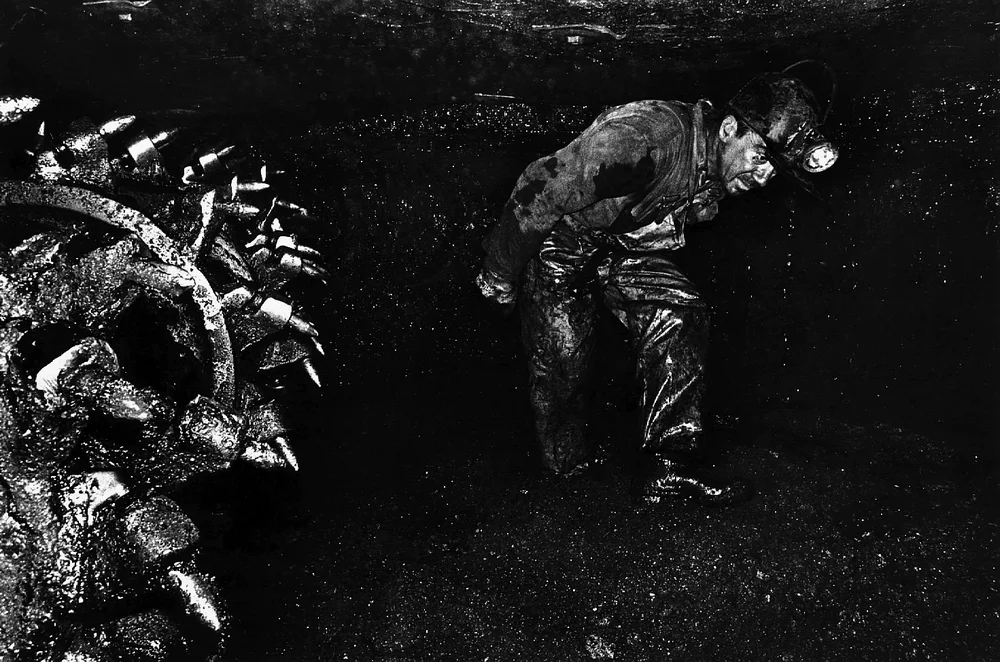
This past April, President Donald J. Trump issued one of the wackiest, fact-challenged and ineffective executive orders of his second term. He vowed to revive the coal industry, calling the notoriously polluting fuel “beautiful” and “clean.”
And nothing – not even a government shutdown – would stop him from the swift completion of his appointed rounds.
Coal is abundant and cost effective, and can be used in any weather condition [as opposed to solar?]. [T]he industry has historically employed hundreds of thousands of Americans. [According to the Mine Safety and Health Administration (MSHA) 68,334 miners were employed in 2024, down from 83,022 in 2018.] … Our Nation’s beautiful clean coal resources will be critical to meeting the rise in electricity demand due to the resurgence of domestic manufacturing [still waiting for that] and the construction of artificial intelligence data processing centers [thank goodness for those data processing centers, sponsored by six of the largest corporations on the planet, that will suck up huge amounts of energy making climate change even worse.
In reaction to Trump’s announcement, ABC News reported that Trump’s “quest” to provoke a resurgence of coal production is “farfetched and unlikely, according to energy experts.”
That, there, is an understatement. Coal has receded for economic reasons, not burdensome regulations or the mythical “war on coal.” Natural gas is cheaper than coal, easier to extract, and more efficient as fuel for modern power plants. The industry has shrunk precipitously over the last 25 years, leaving MAGA states like West Virginia without jobs that allow workers live middle class lives. Coal shrank from a 42% share of energy generation in 1990 to 16% over the past few years, a 38% decrease, even as natural gas use surged. As of 2023, fossil fuels generated almost 60% of electricity in the United States. Natural gas contributed 43.1% of this amount and coal remained steady at 16.2%. Nuclear accounted for 18.6%, and renewables contributed 21.4%.
But the Trump administration never lets reality get in the way of favors to its supporters.
Interior Secretary Doug Burgum, former governor of North Dakota, said “President Trump promised to put American energy workers first, and today we’re delivering,” Burgum insisted. “By reducing the royalty rate for coal, increasing coal acres available for leasing, and unlocking critical minerals from mine waste, we are strengthening our economy, protecting national security, and ensuring that communities from Montana to Alabama benefit from good-paying jobs. Washington doesn’t build prosperity, American workers and entrepreneurs do, and we’re giving them the tools to succeed.”
Burgum recently announced the opening of an additional 13.1 million acres of federal land for lease to coal producers. By late fall 2025, coal leases covered a mere 405,000 acres of public land, tracking the downward trend of coal production nationwide.
Dreary, Desperate and Deadly
Meanwhile, among the miners themselves, conditions are dreary, desperate and deadly.
Coal miners are needlessly paying the price of coal production. A growing number of coal miners have contracted black lung disease because they inhaled small particles of coal dust and silica on the job. And particularly severe forms of black lung affecting younger miners more quickly. Symptoms include shortness of breath, chronic coughs, chest tightness, production of excess sputum, and debilitating fatigue. The disease is especially prevalent among miners digging coal deep underground and it’s gotten worse over recent years:
Of the 11,500 coal miners from central Appalachia with X-rays analyzed by NIOSH-certified readers from mid-2020 through mid-2025, 55% had some form of black lung with the highest annual rate — 62% — recorded among miners seen in the past year, according to researcher Kirsten Almberg at the University of Illinois Chicago. That compares to 41% elsewhere in the U.S. over the same five-year period.
Experts say that’s because much of the easy-to-reach coal has already been extracted in West Virginia and neighboring Virginia and Kentucky, forcing miners to use massive equipment to eat through walls of quartz-filled sandstone to reach the remaining thin coal seams. This creates excess dust laced with shards of silica, which also cause lung cancer and kidney disease. It’s 20 times more toxic than coal dust, the major culprit of the past that often sickened older workers. The silica crystals embed in miners’ lungs, causing chronic inflammation and eventually irreversible scarring that peppers X-rays with chalky spots. It leaves proud, once-strong men skinny and weak. They choke on their food and gasp after just a few steps, cradling shiny cylinders that provide a lifeline of oxygen through tubes snaking into their nostrils.
“You go from being normal to where … one day you try to do something you used to do, and you can’t do it and you’re just heaving to catch your breath,” miner Mark McCowan told NPR reporter Howard Berkes in 2012. “And you say this is crazy. It can’t be this bad. And then you realize a couple months down the road that it can be. And you realize a year down the road after that you ain’t seen nothing yet.” He was 47.
Trump Reverses Actions That Protect Miners
During President Obama’s second term, OSHA — struggling through the excessive obstacles designed to tangle rulemaking up in knots — issued a rule on June 23, 2016, to prevent and protect construction, foundry and other workers from silica exposure. But coal miners do not fall under OSHA’s jurisdiction. MSHA still had to act to protect miners from silica hazards.
MSHA followed slowly. The Biden administration finally issuing a silica rule to protect miners in April 2024. That standard cut permissible silica dust levels inside mines from 100 to 50 micrograms per cubic meter of air averaged over an eight-hour shift. The new standard mandated a proactive solution to this deadly problem, requiring engineering controls, such as ventilation systems, dust suppression devices, enclosed cabs or control booths with filtered breathing air. Administrative controls like better housekeeping procedures and cleaning of spills are also required.
Coal mine operators were given 12 months to come into compliance with the final rule’s requirements. Coal miners were hopeful that enforcement of the rule would protect them from black lung.
Meanwhile, as part of his plan to defang all the agencies that engage in woke science, the Trump administration decimated NIOSH, the research agency located at the Centers for Disease Control that provides the research on workplace health and safety hazards that OSHA and MSHA need to make enforcement plans and complete rulemakings. Nine hundred of the agency’s 1,100 employees were terminated. Included in the wreckage was NIOSH’s black lung surveillance program that the agency runs by Congressional mandate.
Following protests by labor groups and members of Congress, including mine workers as well as a lawsuit, the administration reinstated 328 employees. Health and Human Services Secretary Robert Kennedy Jr. said that most of the reinstated workers were in West Virginia and Ohio.
In May 2025, West Virginia U.S. District Court Judge Irene Berger, an Obama appointee, ordered NIOSH’s Coal Workers Health Surveillance Program back into operation. The program is mandated by Congress and, in addition to doing health research, offers workers health screenings that detect black lung and other occupational diseases.
But that wasn’t enough punishment for this nation’s coal miners. Back in the federal Court of Appeals for the Eighth Circuit, an array of industry groups, including the National Mining Association sued to overturn MSHA’s new silica rule. A three-judge panel granted the petitioners a stay of the rule’s implementation that has not been lifted. The panel turned down efforts by the United Steelworkers and United Mine Workers to intervene in the lawsuit. Rumors have it that the agency and the industry parties are discussing a settlement.
On April 8, 2025, responding to industry and Congressional opposition to silica protections, Trump’s MSHA announced a four-month “temporary enforcement pause” of its final silica rule. The reason: the (self-inflicted) “restructuring” of the NIOSH’s Pittsburgh Mining Research Division and the National Personal Protective Technology Laboratory may impact the supply of approved and certified respirators and personal dust monitors. According to MSHA, “given the unforeseen NIOSH restructuring, and other technical reasons, MSHA offers this four-month temporary pause to provide time for operators to secure necessary equipment and otherwise come into compliance.”
Then, in August, the Trump administration “paused” the standard for another two months. It still has not come into effect.
Coal Industry Promotion Defies Government Shutdown
When the government shut down at the beginning of October over Democrat’s refusal to vote in favor of a continuing resolution without changes in the financing of health care, 700,000 federal employees – including most MSHA and OSHA inspectors — were furloughed.
Only federal employees with “essential” jobs were allowed to work during the shutdown. No OSHA or MSHA staff — aside from a few inspectors (in case of fatalities or catastrophes) — were considered “essential.”
But no one was more “essential” than the staff responsible for carrying out the president’s plans to increase fossil fuel and decrease renewable energy. Some processed permits for companies extracting coal, oil, and gas from federal lands while others formulated plans to remove limits on the greenhouse gases that cause climate change.
The clash between Trump’s endorsement of coal and neglect of miner health problems was predictable. He cannot bring coal back — at least in this country — although the Asia-Pacific region produces 80% global coal production. As of 2024, China produced 4,780 million tons, India contributed 1085, and Indonesia 836. The United States produced 464 million tons. Production dropped 49% between 2014 and 2024 and is expected to keep falling despite the Trump administration’s efforts.
Given the Trump administration’s frighteningly effective rejection of climate change as an existential problem for the planet, coal is not just killing miners who have become the canaries in the earth’s coal mine: their plight is horrible evidence of the problems that will plague our children.
This is a horrible situation. But one minor correction. We issued OSHA’s Silican standard on March 25, 2016, not June 23. The goal was to ensure in could not be overturned under the CRA.
In regard to CWP (aka black lung) and silicosis, it seems to me that nobody is pointing out what appears to be a serious problem: neither operator nor MSHA sampling data can be correlated to the resurgence of CWP and silicosis among miners. I don’t believe that sample data that reflects compliance with mandatory health standards can be relied upon by miners. Consequently, I do not believe that lowering respirable dust and silica exposure standards will necessarily change the prospects of miners developing CWP and/or silicosis. We need to look at MSHA’s and operators’ sample data, and determine if it is actually effective. I worked in the legal department of a major coal producer, and our sample data was overwhelmingly in compliance–and yet our miners were still diagnosed with CWP. According to our–and MSHA’s–sample results, it should not have happened. But it did (and does), and to me, that indicates that we need to examine the effectiveness of the current compliance sampling paradigm. More sampling won’t resolve the issue, if the manner and timing of the testing is a problem, itself.