
On April 18, 2024 the Biden administration issued a long awaited new silica rule to protect coal miners — more than 50 years after NIOSH recommended new exposure limits.
But this victory for the nation’s coal miners was short-lived. Before the new rule could come into effect in April 2025, the Trump administration postponed enforcement for four months, then for another two months.
Yesterday, as part of its deregulatory agenda, the administration announced that the Mine Safety and Health Administration (MSHA) would “reconsider” the rule with the intention of making changes — likely those requested by mine operators and Congressional Republicans.
The new silica rule would have lowered the Permissible Exposure Limit (PEL) for respirable crystalline silica to 50 micrograms per cubic meter of air – half the previous limit, and included requirements for controlling and monitoring exposures to respirable crystalline silica.
The new MSHA rule also required mine operators to offer free medical monitoring for miners to detect black lung and other respiratory diseases earlier. The new PEL matches the silica limits established by OSHA in 2016 to protect construction workers and other general industry employees who were exposed to silica.
Corporate and Congressional Opposition
Last April, days before mine operators would be required to comply with the new standard, MSHA announced a four-month “temporary enforcement pause” of its final silica rule. That “pause” was scheduled to end August 18. The reason: the “restructuring” of the NIOSH’s Pittsburgh Mining Research Division and the National Personal Protective Technology Laboratory may impact the supply of approved and certified respirators and personal dust monitors. According to MSHA, “given the unforeseen NIOSH restructuring, and other technical reasons, MSHA offers this four-month temporary pause to provide time for operators to secure necessary equipment and otherwise come into compliance.”
This “unforeseen” restructuring, of course, was the result of the virtual shuttering of NIOSH just weeks before by DOGE and the Trump administration.
At the end of July, Committee Chair Tim Walberg (R-MI) and six other Committee Republicans sent a letter to MSHA’s Deputy Assistant Secretary for Policy, James McHugh, expressing their support for “efforts to give businesses and workers relief from the overly burdensome regulations promulgated by the Biden-Harris administration,” and reminding McHugh that MSHA’s silica standard “falls squarely within the purview of President Trump’s deregulatory EOs [Executive Orders]” that “require agencies to rescind or revise regulations that impose significant costs.”
Then as the initial 4-month “pause” came to an end, MSHA announced a further delay due to negotiations resulting from legal challenges by the the mining, sand and gravel industries.
Despite the whining from coal operators, the Charleston Gazette-Mail estimates that compliance with the new rule would have cost large coal operators a tiny fraction of their profits.
Tulsa, Oklahoma-based parent company Alliance Resource Partners L.P.’s total revenue for2024 was $4.89 billion, according to a U.S. Securities and Exchange Commission filing. That means the first-year silica rule compliance costs projected by Alliance Coal — Alliance Resource Partners’ mining operations holding company — would comprise just 0.39% of its parent company’s 2024 revenue.
Alliance Resource Partners sold 33.3 million tons of coal in 2024, meaning its rule compliance costs would amount to $0.57 per ton sold.
The likely rollback of the rule has upset miners and advocates for coal miners:
Gary Hairston, a retired West Virginia miner who is also the National Black Lung Association president, said the rule itself was a big win, but the waiting game to see it in action has been frustrating.
“I don’t understand why the companies don’t want to enforce it,” Hairston said. “I know all they think about is money, but you want to take care of the person that’s working for you because it means less people going back into the coal mines.”
Quenton King, government affairs specialist for miner and environmental advocacy group Appalachian Voices, said in a statement that “Every delay in reducing the amount of silica dust miners are exposed to means more miners becoming sick and dying,”
Legal experts question whether the Mine Safety and Health Act allows MSHA to weaking existing standards. Section 101(a)(9) of the Mine Safety and Health Act states that “No mandatory health or safety standard promulgated under this title shall reduce the protection afforded miners by an existing mandatory health or safety standard. Mining attorney Sam Petsonk said that “If the agency is rewriting this rule, it better be only for the purpose of strengthening and broadening the rule.”
A Growing Epidemic of Lung Disease
Because coal seams have become narrower and harder to mine, miners need to cut through more rock containing cancer-causing silica
Mine workers and researchers have attributed central Appalachia’s sharp increase in black lung incidence among increasingly younger miners cutting into more surrounding rock as coal seams thin, yielding greater exposure to silica dust.
NIOSH researchers found in a 2018-published study of lung exams collected from 1970 to2017 that 20.6% of miners with careers of 25 years or more in West Virginia, Kentucky and Virginia had black lung — a pronounced increase following a national low point in the late1990s.
The data spanning July 2019 through June 2023 show 83.4% of miners with large opacities on chest X-rays seen at federally supported black lung clinics were in those three states, with West Virginia having a persistently high concentration of such miners.
Aside from the rollbacks in regulatory protections for miners’ health, the agency has been crippled by tight budgets and lack of resources. Even though coal production is falling in the United States, the resources of MSHA have been falling faster:
MSHA’s estimated 1,729 full-time equivalent positions and $387.8 million for appropriation for fiscal year 2024 were 25% and 24.2%, respectively, below their estimated fiscal year 2008amounts when adjusting for inflation, according to MSHA budget plans for those years. Those declines were much steeper than a concurrent 14.7% decline in the nation’s mines, meaning the MSHA’s resources decreased faster than the mines it was created to regulate.
Over and above the additional preventable deaths that this action will cause, more miners have been killed this year than last year. Thirty workers under MSHA’s jurisdiction have already been killed on the job in the first 100 months of this year, compared with 28 in 2024. We don’t know how many miners will be diagnosed or die from Black Lung this year, or how many more will die because of the ongoing delays in enforcement of MSHA’s silica standard.
Thank you for bringing this issue to the forefront, Jordan. MSHA’s inaction implies that the lungs of miners are less susceptible to the effects of silica dust than those of construction workers who are covered by OSHA. Very disheartening.
True. Although if the OSHA silica standard had not come into effect yet, I would imagine the construction industry would have convinced the Trump administration to “revisit” that as well. As it was ,they sued OSHA and lost bigly.
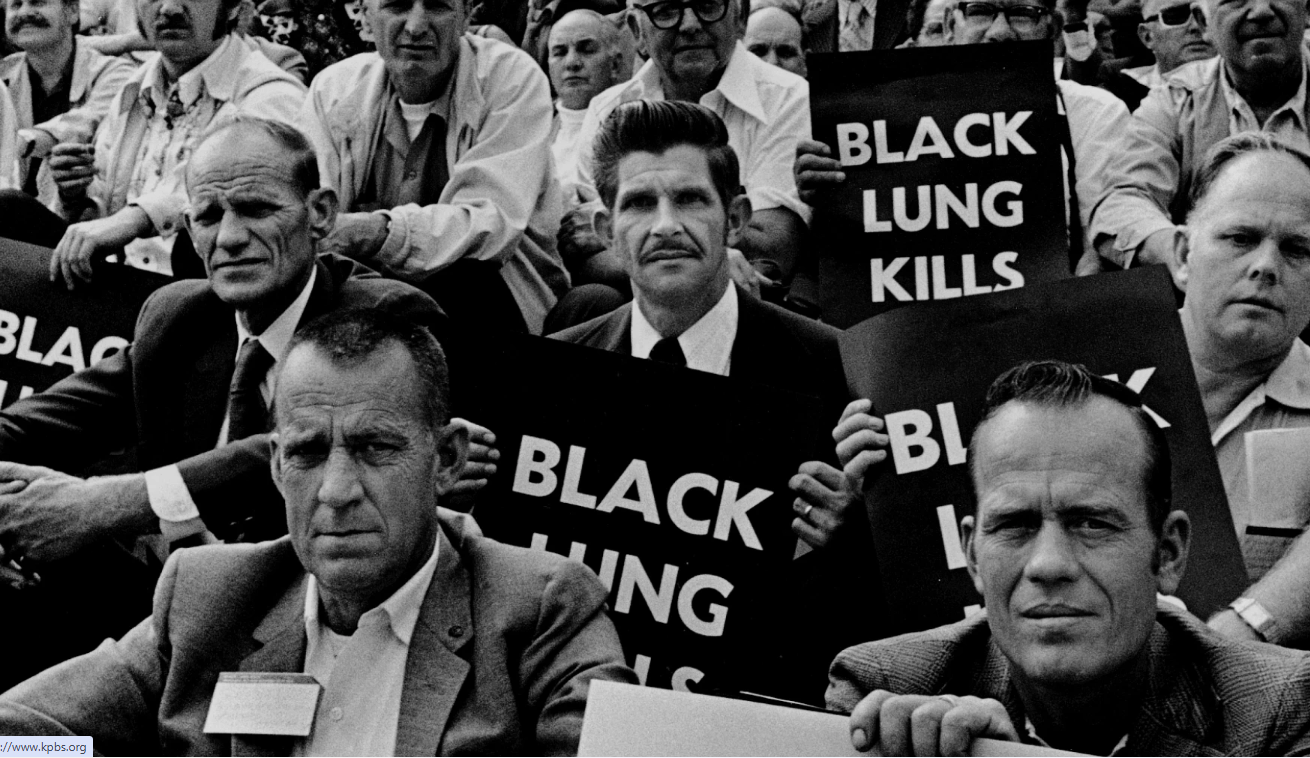
The above 1968 picture of unauthorized striking coal miners at the Capitol in Charleston, WV demonstrating for greater recognition of black lung disease and disability compensation, better controls of coal dust exposure in the mines and mine health and safety in general, all in opposition to the ruthless coal operators, the bribed politicians and the corrupt authoratarian union leadership all led to some real changes for the better. Some lasted and some didn’t. This image says it all. Its more, all about power, while innovation, technology and regulation are secondary. When working people organize and fight for improvements in their lives, they win!