
Anyone who reads Confined Space regularly is likely depressed about the ongoing shrinking of OSHA’s ability to police working conditions in this country. At the end of last year In 2024, there are only 768 federal OSHA inspectors and 1,034 state inspectors to oversee the 11.8 million workplaces and 161 million workers under the OSHA’s jurisdiction. That means that OSHA could only reach every workplace in the country every 165 years. And that number threatens to get worse.
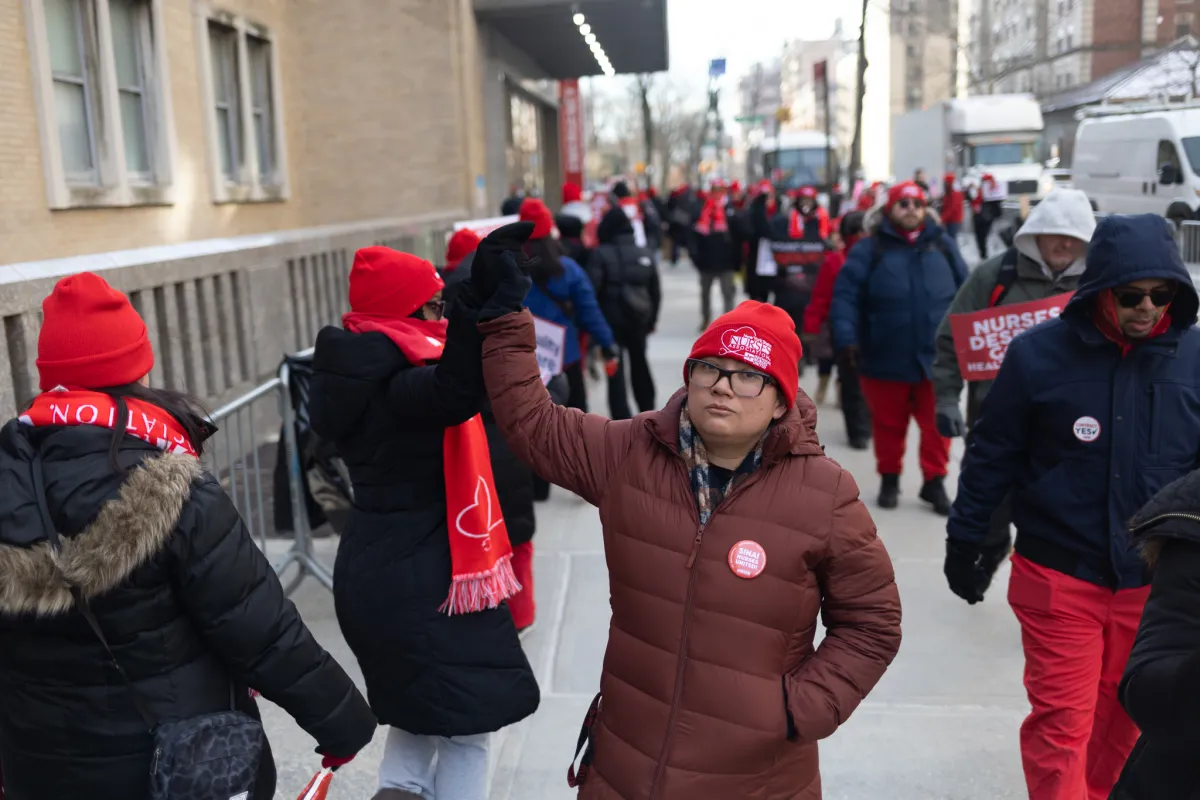
But even amidst the unrelenting news about the horrors of Minneapolis and authoritarian assaults on our democracy, there are some glimmers of hope out there. In this case a stirring story of almost 15,000 brave New York nurses, organized by the New York Nurses Association, walking out on strike. The strike, which began January 12, is in its fourth week. The main problem is safety issues — safety for nurses and safety for patients.
The strike is also dealing with wages and nurses health benefits. Nurses are asking for pay increases of 7 percent the first year, 6 percent the next year and 5 percent in the third year. The hospitals are offering far less.
Three hospital systems are affected by the walkout, Montefiore, Mount Sinai and New York-Presbyterian. As the strike drags on, Gov. Kathy Hochul and Mayor Zohran Mamdani urged the hospitals and the union to keep negotiating.
Nurses Are Getting Beaten Up
Workplace violence is not a new issue for nurses.
In 2017, a doctor went on a rampage at a Bronx hospital with a rifle, killing another physician and wounding six other people before setting himself on fire and shooting himself, the authorities said. More recently, in November, a gunman threatened to shoot up Mount Sinai, an episode that underscored nurses’ concerns.
In addition, the nurses association pointed to an incident in November when a man allegedly threatened to “shoot up” a Mount Sinai hospital before being killed by police. In another incident in early January, a man allegedly threatened staff with a sharp object before barricading himself in a Brooklyn hospital room. He was shot and killed by police.
We’re also fighting for protections from workplace violence, because nurses shouldn’t fear for our lives on the job. — Mount Sinai Morningside Hospital Sheryl Ostroff
But these are not isolated incidents. As Mount Sinai Morningside Hospital Sheryl Ostroff wrote in today’s New York Times,
We’re striking so that nurses and patients alike can be safe. We’re fighting for adequate numbers of nurses to care for the number of patients we see. We’re also fighting for protections from workplace violence, because nurses shouldn’t fear for our lives on the job.
More than 80 percent of nurses experience workplace violence each year, according to one industry survey. The rate of violent incidents is reportedly increasing, too. Almost all of these assaults are perpetrated by patients, though patients’ family members can also threaten our safety. People don’t realize that hospitals are increasingly dangerous places to work in. Because nurses spend more time than anyone else with patients, we often get the brunt of their anger with the health care industry, lack of adequate services and long wait times.
I have worked with nurses throughout my entire career and some of my closes family members work as nurses today. You can’t talk to any nurse without stories of being kicked, punched, pushed, hit or threatened by patients. And no nurse went into the profession expecting to become mixed martial arts expert in order to do their job safely.
The solutions to workplace violence are well recognized and well documented by OSHA.
Ms. Anderegg, the Mount Sinai nurse, said that she wanted metal detectors and armed police officers or guards at hospital entrances, something that some other hospitals have. She said that since the strike began, police officers have been present outside Mount Sinai. “What do they think we are going to do, storm the hospital?” she said.
A state law will go into effect this year that requires hospitals in New York City and the surrounding counties to have trained security personnel or an off-duty police officer present at all times in the emergency department. The law notes that about 70 percent of emergency room nurses say that they have been assaulted at work.
Both Senator Bernie Sanders (I-VT) and NY Mayor Zorhan Mamdani have joined workers on the picket lines.
“When we see a strike, people forget that that is not where workers want to be. The strike is an act of last resort. What workers want is to be back at work. This is about safe working conditions. This is about a fair contract. This is about dignity,” Mamdani said.
“What this is in fact about is recognizing the worth of each and every nurse in this city.”
And Sanders added:
“The people of this country are sick and tired of the greed of the healthcare industry,” Sanders said.
“They’re tired of the drug companies ripping us off, the insurance companies ripping us off and hospital executives getting huge salaries. Don’t tell me you can’t provide a good nurse-staff [patient] ratio when you’re paying your CEO at New York-Presbyterian $26m a year, the CEO at Montefiore $16m a year. Mount Sinai $5m a year.”
Patient Safety
Nurses work long hard hours for inadequate wages and lousy conditions, and they struggle across the country for safer conditions for themselves and for their patients. One thing they all have in common is that they deeply care about the welfare of their patients. And they understand that short staffing in hospitals doesn’t just lead to burnout and make violent incidents more likely, short staffing also affects patient safety
In 2024 alone, New York-Presbyterian CEO Steve Corwin received $26.3 million in total compensation while Montefiore CEO Dr. Philip Ozuah received around $16.3 million in compensation.
And even their victories are often hollow and short lived. As Ostroff continues: :
A few years ago, I was part of a union-led fight to address short staffing within our emergency room. Nurses sometimes had as many as 16 or 17 patients at a time; when nurses have that many patients, we don’t take breaks, eat or go to the bathroom. A third-party arbitrator ruled in our favor in June 2023, ordering the hospital to pay nurses who worked understaffed shifts and to hire more nurses to fill vacancies. But management failed to fill the open positions for months, leaving us understaffed by as much as 35 percent. This led to a second ruling two years ago in which another arbitrator ordered my emergency department to pay almost $1 million in compensation to my colleagues and me. Our fight paved the way for similar orders at multiple Mount Sinai departments, ultimately amounting to over $2 million in payments to overworked nurses.
Despite the arbitrators’ orders, Mount Sinai continues to understaff units, creating unsafe conditions for nurses and patients. When you don’t have enough nurses working a shift, those who are working end up with higher caseloads, angrier patients who are upset by the lengthened wait times and less safe hospitals. This must change.
To adequately care for patients, we need to have a safe nurse-to-patient ratio. California requires there to be one nurse for every four patients in the emergency room. New York doesn’t consistently enforce its staffing requirements for intensive care units, and the New York State Nurses Association has found that some hospitals have left emergency room nurses with a staffing ratio as high as 10 to one. Our patients receive slower, less attentive care when we do not have enough nurses to support them.
A Hard Strike
Recent strikes have lasted only a few days, but this time, the hospitals dug in for the long haul, hiring hundreds of temporary nurses. Dr. Brendan G. Carr, the chief executive of the Mount Sinai Health system said that the three Mount Sinai hospitals affected by the strike were operating under the assumption that they would need replacement nurses for a few more weeks. So far, the affected hospitals collectively have spent more than $100 million on short-term staffing.
Nurses with families and small children are going without paychecks and health insurance. As the City reports: “Nurses who spoke with THE CITY all agreed that missing a paycheck hurts, but going without health coverage for themselves and their dependents is even more distressing. Still, they’re maintaining their resolve. ‘Solidarity is important to me, and I identify very strongly as a union nurse,’ said the Mount Sinai Hospital nurse practitioner. “It’s not a good situation but this is, I think, bigger than not having income for a couple of weeks.”
The nurses, meanwhile, have been chanting, “One day longer, one day stronger.”
Despite a bitterly cold spell and heavy snowfall, the picket lines have been full of striking nurses and supporters. Outside Mount Sinai Hospital one recent day, hundreds of nurses held hands, forming a chain that snaked around several blocks. Nurses have gone on runs, jogging from one hospital to another.
Outside Montefiore Medical Center in the Bronx, union organizers and the father of one of the nurses have been serving soup to 200 strikers each day: mushroom beef barley one day, chicken lemon orzo another day.
Where is OSHA?
When I started working for AFSCME in 1982, I had not been aware of workplace violence in healthcare or social services. All you heard about in those days was occasional instances of a postal worker “going postal.”
But the more I talked with AFSCME-represented nurses, the more I realized the seriousness of the problem — especially for those workers in social services, mental health and hospital emergency rooms. Even more upsetting was the failure of hospitals and the Occupational Safety and Health Administration to do anything about the problem even though for many years workplace violence was the second leading cause of workplace death in the country, and the leading cause for women.
In 2016, OSHA finally started work on a workplace violence standard to protect health care and social service workers, but little progress has been made over the past 9 years, and the Trump administration recently relegated the workplace violence standard to the “long term agenda.”
In the 1980s and early 1990s, most health care administrators as well as federal OSHA leadership refused to consider workplace violence an appropriate issue that an agency that dealt primarily with falls, machine guarding and chemical issues could – or should — address. The only solution they saw at that point was to increase staffing levels, a management prerogative that OSHA was loath to interfere with. Meanwhile, state health departments pleaded poverty and rejected the notion that a worker’s right to a safe workplace should compete with a patient’s right to not be restrained, physically or pharmaceutically.
As the healthcare worker crisis grew, two events in the early 1990s began to change OSHA’s mindset. In 1992, the US Department of Labor Solicitors Office issued an opinion finding that violence could be considered a hazard
enforced under OSHA’s general duty clause, a general requirement that employers provide a safe workplace. The hazards were serious and recognized and there were feasible ways to minimize or eliminate the hazards.
Shortly thereafter, following the brutal stabbing death of a social worker by her client, CalOSHA developed guidance that took the same approach to addressing workplace violence that health and safety officials took to address other hazards: Identify the risk factors, then apply the hierarchy of controls: engineering controls like locked doors and communications devices, and administrative controls like training and adequate staffing.
Finally, in 1996, federal OSHA issued its first Guidelines for Workplace Violence in Health Care and Social Services (updated in 2015) and began enforcement under OSHA’s General Duty Clause. (You can read a more detailed history in a book review I wrote several years ago.)
In 2016, OSHA finally started work on a workplace violence standard to protect health care and social service workers, but little progress has been made over the past 9 years, and the Trump administration recently relegated the workplace violence standard to the “long term agenda,” which means they have little intention of working on it. To speed up the process, the US House of Representatives passed bipartisan legislation in 2019 and in 2021, that would have required OSHA to issue a workplace violence standard within 24 months. The bill never came to a vote in the Senate. (You can read a very detailed Congressional report supporting the legislation here.)
Now What?
For nurses that care so much about their patients’ welfare, walking out isn’t easy. But it needs to be done.
The moral injury of needing to go on strike to have our concerns about staffing and workplace violence taken seriously is the hardest injury to process. We have an ethical duty to care for our patients; right now, the best way to achieve that is to fight for staffing levels and protections that will help save their lives and keep us healthy enough to keep working. It’s the guilt that eats at us when we don’t have the time to see a patient because of the lack of nurses. I’m a nurse because I love it and it gives me purpose. It’s in my DNA — and there’s nothing else I can imagine doing. We need hospitals to do their part to create safer conditions for patients and staff members, because nurses can’t take this any longer.
There are now rumors that the strike may be coming to a conclusion. We shall see…
Workplace violence, short staffing, burnout and other problems are certainly not unique to New York City. Nurses across the country have the same problems. And they are likely to get worse as the cuts under Trump’s “Big Beautiful Bill” threatens major cuts to Medicaid and federal healthcare funding across the country.
We’ll see how the New York nurses strike turns out. But it’s important — especially in these days when Trump and Republicans are focused on defunding the workplace police — that workers are able to stand up and demand safe working conditions.
But what makes these nurses in New York different than most nurses in the country is that they belong to a strong union. They can make demands based on hard evidence, act collectively and walk out in mass when those demands are ignored.
This is an advantage that most workers in the country — as well as most nurses — don’t have. Only around 20.4% of Registered Nurses and 10% of Licensed Practical/Vocational Nurses in the U.S. are union members, significantly higher than the overall workforce average, but still representing a tiny fraction of nurses who disparately need unions to help them improve their working conditions and the safety of their patients. Hospital systems fight fiercely to prevent workers from organizing, hiring armies of high-priced anti-union lawyers and consultants to try to frighten nurses out of exercising their right to organize.
And this post only deals with violence in hospitals. Any reader of the Weekly Toll knows that retail workers are routines assaulted and killed. Unfortunately, OSHA does less to protect them and less than 5% of retail workers are organized.
We’ll see how the New York nurses strike turns out. But it’s important — especially in these days when Trump and Republicans are focused on defunding the workplace police — that workers are able to stand up and demand safe working conditions.
Thank you for this thoughtful and power piece on the NYSNA strike. Our members remain remarkably strong and undaunted, though the employers have acted abysmally so far.