

A funny happened in Nevada last year. Nevada OSHA issued three willful violations totaling more than $400,000 to Elon Musk’s Boring Company after firefighters suffered serious chemical burns at a Boring site. The Boring Co. is building a privately owned transportation tunnel system under Las Vegas called the Vegas Loop.
Hours after the citation was issued, Boring Executives called the office of Nevada Governor Joe Lombardo. The next day all of the OSHA citations were mysteriously withdrawn. They weren’t just reduced from “willful” violations to “serious” violations; they completely disappeared.
In addition, no explanation was provided in the case file and critical documents disappeared — including any mention of the call or meeting with Boring officials.
OSHA’s review of the shady circumstances basically gave the state a clean bill of health without even addressing the major question: were Nevada’s actions a result of unethical or illegal political influence by Elon Musk’s company?
Fortune magazine Senior Reporter Jessica Mathews published an in-depth investigative story of these events last November, which I summarized in a Confined Space post shortly thereafter.
To refresh your memory, following the severe chemical burns suffered by the firefighters, OSHA issued a $425,595 citation to the Boring Company that included three willful violations for not providing appropriate training and protective equipment to the workers. Then it got interesting:
On May 28, hours after Nevada’s workplace safety agency served notice of more than $400,000 in fines to Elon Musk’s $5.6 billion tunneling startup the Boring Company, the phone rang at Nevada governor Joe Lombardo’s office.
Boring Co. president Steve Davis was on the line. Boring Company was challenging citations from Nevada’s workplace safety regulator blaming it for chemical burns two firefighters had suffered in its tunnels during a training exercise.
By the next afternoon, a group of high-ranking state officials, including the governor’s state infrastructure coordinator who took the call, were convened in a room with Davis, who was himself wrapping up a stint in Washington D.C. helping Musk run the Trump administration’s Department of Government Efficiency (DOGE). At the beginning of that meeting, the citations and fines—among the agency’s largest in a decade and a potential threat to Boring’s plans to build tunnels in other U.S. cities—were summarily rescinded.
And the citations and penalties were not the only things that disappeared.
The record of the Governor’s office meeting with Musk’s company was removed from a public document without explanation. More irregularities in the case file occurred: Documents weren’t saved to the file, and a document intended to provide reasoning for revoking the citations was left out.
Democratic state legislators in Nevada were not amused with OSHA’s actions, nor were they happy that the Boring Company had been accused of violating environmental regulations nearly 800 times in the last two years. Democratic members of the Nevada Assembly’s Growth and Infrastructure Committee held an interim meeting early this month (before the federal OSHA response was issued) to address safety, environmental and security concerns raised around the Boring Company’s Vegas Loop project. Boring Company offices and representatives of the Nevada Governor’s office were invited but declined to attend.
One legislator, Sen. Rochelle Nguyen, noting that “Removing, destroying, altering or concealing any public record in a public office is a Category C felony in Nevada,” asked officials “Did you file any kind of police report?”
Kristopher Sanchez, director of the Department of Business and Industry, said in response there was an internal investigation, but no one was found accountable for modifying or deleting the file and no police report was filed.
Committee chair Assemblyman Howard Watts (D-Las Vegas) announced that he will be “bringing forward a bill to ensure they and other bad actors are held accountable by our regulators.”
Federal OSHA Launches an Investigation
Based on these developments, a Complaint Against A State Program Administration (CASPA) was filed with federal OSHA, launching an investigation. Federal OSHA has the responsibility to oversee state OSHA programs — like Nevada’s — to ensure that the states’ programs are at least as effective as the federal program. Anyone who feels that the program is not meeting those conditions can file a CASPA.
Last week federal OSHA released its report. The verdict? A few small problems, but basically a clean bill of health.
Move along. Nothing to see here.
Federal OSHA’s determined that “NV OSHA had reasonable justification to withdraw the issued willful citations….We determined that the prima facie elements necessary to establish a willful violation were not satisfied. The evidence gathered by NV OSHA during their investigation did not substantiate the employer demonstrated intentional disregard or plain indifference to the identified hazards.”
The report also recommended that Nevada OSHA tighten up its procedures a bit.
And that was pretty much all that Nevada officials and the press ran with.
“Federal regulators uphold Nevada OSHA’s withdrawal of citations for Elon Musk firm,” the Las Vegas Sun headlined.
“Federal OSHA officials OK justification for dismissal of citations issued to Boring Co.” the Nevada Independent screamed.
Like the famous Sherlock Holmes story “The Dog that Didn’t Bark,” the real story here is not what OSHA found, but what the agency didn’t even explore.
Nevada OSHA assured everyone that it had “proactively implemented” federal OSHA’s recommendations. “These improvements reflect our ongoing commitment to transparency, accountability, and continuous improvement in workplace safety enforcement,” DIR Administrator Victoria Carreón said.
And Department of Business and Industry Director Kristopher Sanchez said that
Today’s findings merely confirm what the Division of Industrial Relations legal counsel identified—that the citations issued did not meet the required legal standard. After identifying the deficiencies, Administrator Carreón and her team acted quickly to institute policies and procedures to address those concerns. I have full faith that the team at Nevada OSHA will continue to provide fair and impartial regulatory oversight of businesses that operate throughout the state,” said
The Incredible Disappearing Citation
The OSHA report stated that “We found merit in the following allegations and make recommendations as discussed below.” But like the famous Sherlock Holmes story entitled “The Dog that Didn’t Bark,” the real story is not what federal OSHA found, but what the agency failed to even investigate.
First, OSHA only addressed Nevada’s decision to eliminate the willful violations. It did not address the elimination of all of the violations.
A little background. Nevada OSHA issued three willful violations against the Boring Company. In order for OSHA to sustain a willful violation, the agency has to prove that the employer intentionally disregarded OSHA standards or acted with “plain indifference” to employee safety. That can be a heavy burden for OSHA to prove and resource-intensive to defend — especially since employers are much more likely to contest a willful violation than a serious violation.
For a serious violation, on the other hand, OSHA only has to show that “substantial probability that death or serious physical harm could result.” For that reason, willful violations are always carefully reviewed by agency lawyers before being issued. In this case, Nevada OSHA contended that the willful violations were somehow issued without legal review.
Becuase of the heavy legal burden involved in willful violations, it is not unheard of for OSHA to initially issue a willful violation and then downgrade it to a serious violation if new evidence or other factors are considered.
But there is a process for downgrading the status of violations. And that process was not followed according to an NV OSHA employee — and federal OSHA.
“There is a defined process, and we didn’t follow it,” says one of the people that worked on the case file. “It wasn’t the agency that decided to do that—it was above the agency,” the person added, speaking on condition of anonymity because they feared retaliation from speaking about internal OSHA matters.
After a citation is issued, the employer has 15 days to engage OSHA in informal settlement discussions before deciding whether to contest the citation. Sometimes during those discussions, the employer will make a convincing argument that a willful violation is not justified, or sometimes OSHA will decide that its case is weak and reduce the violation from willful to serious to avoid expending the resources to defend a weak case and possibly losing in court. Often OSHA will offer to reduce the amount of the penalty in order to convince the employer not to contest the citation.
In this case, federal OSHA judged that
In our analysis NV OSHA had reasonable justification to withdraw the issued willful citations. Our evaluation of the violation worksheets in the inspection file revealed several inconsistencies, and we determined that the prima facie elements necessary to establish a willful violation were not satisfied. The evidence gathered by NV OSHA during their investigation did not substantiate the employer demonstrated intentional disregard or plain indifference to the identified hazards.
OK, because we’re fair and broad-minded over here at Confined Space, we’ll give NV OSHA and federal OSHA the benefit of the doubt on that one. As I said, sustaining willful violations can be a heavy lift.
But it is much more rare for OSHA to withdraw the entire citation instead of just reducing the “willful” violation to “serious.” Especially if there hasn’t even been informal conference.
So what did the feds say about disappearing the entire citation?
Nothing. Not a word. Except for noting what was already obvious: that “NV OSHA did not provide a justification in the case file to explain their withdrawal of the citations.”
OSHA auditors also noted that a process for withdrawing an entire citation outside of the informal conference process does not exist. But they didn’t seem all that concerned about that rather serious deviation from long-standing established procedures.
Federal OSHA’s firm reprimand of these unprecedented actions consisted of “We have no idea what went on or why, nor do we care. But whatever happened, please try not to do it again.”
The feds also confirmed another thing we already knew: that someone had inappropriately tampered with the case file. Again, OSHA simply restated the known facts:
After the decision to withdraw the willful citations, NV OSHA staff modified or removed relevant documentation from the case file. Documents from the original case file, including the signed citation package, were intentionally removed to align with the withdrawal of the willful citations. NV OSHA staff subsequently modified the narrative to reflect the updated status. We also noted minor discrepancies between diary sheet versions. The original copies of the removed and altered documents were recovered and assessed during this CASPA investigation.
What did the OSHA assessment say about those removed and altered documents? How significant were these actions? Why were the documents removed or altered?
Who knows?
In other words, the OSHA report is not really an investigation or an audit. It’s pretty much just a summary of what happened.
But the feds did have some recommendations:
To address these findings, we recommend that NV OSHA clarify in policy when to engage with their legal counsel, require that critical events and decisions be documented, and clarify how and when it is appropriate to modify case files when there is a citation withdrawal.
In other words: “We have no idea what actually happened or why, nor do we care. But whatever happened, please try not to let it happen again.”
See No Evil, Smell No Evil
Much more troubling than approving the withdrawal of a few citations is federal OSHA’s failure to look into whether any unethical or illegal political influence led to the disappearance of the citations and hiding the documentation. As Fortune’s Matthews described the events following issuance of the Boring citations, “it raises questions about the degree to which a powerful business is able to bend regulatory guardrails to its will and skirt proper oversight, especially as Musk’s consortium of companies become increasingly intertwined with Nevada’s economy.”
Deleting any reference to the meeting between Musk’s people and the Governor’s office, removing any mention of the withdrawn citations in the case file, providing no documentation of the why the citations were withdrawn — all this stinks to high heaven.
I don’t have a copy of the original CASPA that led to this investigation, but I would be shocked if there were no allegations of unsavory and inappropriate political influence leading to NVOSHA’s decision to completely withdraw the entire citation.
But what was in the CASPA is largely irrelevant. Even in the unlikely event that questions of unethical or illegal political influence were not mentioned in the CASPA, OSHA still has the ability — and responsibility — to investigate the allegations and evidence presented in the Fortune article.
“You have substantial evidence that shows there was, I’m not going to use the word illegal, but there was some questionable practices right there, having that removed,” according to former Nevada OSHA chief administrative officer, Jess Lankford.
Indeed.
The whole issue of political influence was wholly ignored in federal OSHA’s report. Like the proverbial elephant — or in this case a Brontosaurus — in the room, the possible corruption that led to Nevada OSHA’s actions was not even mentioned. As if the allegations and evidence never existed.
Yet the whole issue of political influence was wholly ignored in federal OSHA’s report. Like the proverbial elephant — or in this case a Brontosaurus — in the room, the possible corruption that led to Nevada OSHA’s actions was not even mentioned — and apparently not investigated. As if the allegations and evidence never existed.
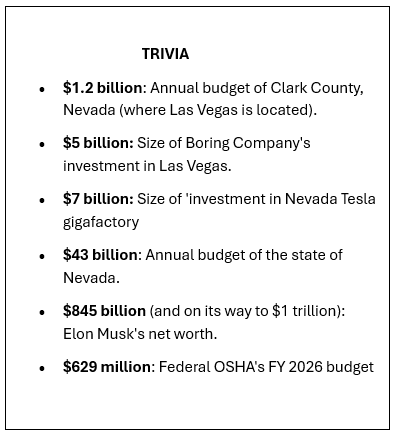
For example, the Governor’s office told Fortune reporter Jessica Matthews that NV OSHA was never been directed by the Governor’s office “to come to a predetermined outcome in the review and resolution of these complaints.”
Did the feds ask for evidence of that claim? Not that we know of.
Nevada OSHA claimed that “At no time did the Department of Business and Industry or Division of Industrial Relations leadership feel pressured or were instructed to withdraw the citations by the Governor, his staff or any third party.”
Did the feds look into whether this claim was true? Who knows?
The state says that “Department and Division leadership at no time instructed Nevada OSHA’s CAO or staff to apply preferential treatment to this case or any other involving the Boring Company, or direct them to delete, withhold or otherwise hide information pertaining to the May 29 meeting.”
Did federal OSHA conduct any interviews that might have indicated whether these claims were true or not? Again, there is no mention of any such inquiries by the feds.
Matthews reported that Nevada OSHA staffers were “alarmed by the handling of these citations and the speed at which the citations were withdrawn and that these actions have made agency employees fear inspecting or regulating Boring Co. in the future.”
It is clear that someone needs to investigate the investigators. Why did federal OSHA let Nevada get away with administrative murder?
Did the feds interview any Nevada OSHA staff to determine if they are still feeling alarmed? Apparently not.
None of the Nevada media seems to be following up on this story, although we’re expecting to hear something from Fortune soon.
It is clear that someone needs to investigate the investigators. Why did federal OSHA let Nevada get away with administrative murder? Why did they avert their eyes from some obvious and very troubling questions that need to be asked and answered. Why didn’t the federal OSHA investigation look into “the degree to which a powerful business is able to bend regulatory guardrails to its will and skirt proper oversight.”
And what does newly installed OSHA Assistant Secretary David Keeling say about this travesty of an investigation?
Only oversight by Congress or further investigative reporting from the media will begin to answer those questions. And we know we can’t expect anything from Congress — at least until next year.
Deplorable!
Ah yes……another “shocker” here with no accountability. Pathetic as always. I wish more wealthy men with money had the balls for once to just step up to the plate, show some class, be accountable and do the right thing in paying a fine that is truly piddly change to them. At least THEN we could have a tad smidgen of respect for them.
This is not the first time a willful violation magically disappeared at Nevada OSHA. During an October 2009 hearing before the House Education and Labor Committee, the mother of a worker killed in a confined space incident at a casino on the strip testified about the reckless disregard of worker safety by Boyd Gaming and her concern about political meddling by the Governor’s office regard a settlement agreement with Nevada OSHA that resulted in Boyd escaping willful violations (at the Orleans Hotel) even though they had been cited for substantially similar violations at its other properties in Nevada over the previous 3 years. Her son and another worker were killed and one other worker was injured after they were directed to enter a poorly ventilated grease pit filled with toxic fumes.
Back then the former Acting Assistant Secretary (and now editor in chief of this esteemed publication) ordered a review of the Nevada State Plan follow the receipt of 2 CASPAs. This also followed a string of construction fatalities on the strip. Federal OSHA identified a number of serious concerns about Nevada OSHA in its review of 25 fatalities over an 18 month period in 2008 and early 2009 .
Mr Barab testified at the Committee hearing: “For example, even though the files examined were primarily cases involving the deaths of workers, only one repeat and one willful violation were cited during the time period covered by the investigation and the single willful citation was reclassified. It appeared that Nevada OSHA avoided classifying violations as willful because the state lacked the management and legal counsel support necessary to uphold a willful classification. The repeat citation was issued to an employer that had committed multiple repeat violations of trenching operations within 12 months; yet, no willful violations were issued in this case.
There were a number of cases which clearly supported the classification of repeat violations but they were not cited as repeat. In the Orleans Hotel case that was the subject of several CASPAs, Nevada OSHA had issued serious, rather than repeat or willful violations, even though the owner of the hotel where the violations occurred had previously been cited for substantially similar conditions at other properties.
Federal OSHA found that in seventeen percent of the fatality cases reviewed, hazards that were identified during inspections were not addressed in citations. In almost one-half of the fatality cases reviewed the state failed to notify families of deceased workers that it was investigating the death of a loved one. Thus, family members, who can often provide pertinent information, were never provided the opportunity to discuss the circumstances of the incident with Nevada inspectors.
The contrast between the Obama era oversight and the Bush era is striking, inasmuch as the previous review by the Bush Administration had found the NV plan “very good overall”.
Mr Barab clarified that “the problems we identified at Nevada OSHA were systemic problems in the management of the agency. We are not casting blame on the
efforts of the dedicated staff who are devoting their lives to ensuring safe workplaces for Nevada workers.”
www.congress.gov/event/111th-congress/house-event/LC6139/text
From my experience as the manager of a state OSHA enforcement office during the 1990s, I can share two separate occasions of being pressured by the head of the agency to drop serious and willful serious violations after the agency head had been contacted by representatives of industry associations representing the entities that my office cited following inspections. My staff and I resisted these pressures and the citations were upheld. My point is that powerful economic interests use political influence to check or reduce regulatory action all the time. It is rare, however, for such influence mongering to become public knowledge as it has in the Nevada instance you highlight here.