

OSHA made a major announcement today: It’s changing posters. Why?
Because they care.
But this is not necessarily good news.
Because the new poster doesn’t do the job.
Posters are Required
A little background. OSHA regulation 1903.2(a)(1) states that “Each employer shall post and keep posted a notice or notices, to be furnished by the Occupational Safety and Health Administration, U.S. Department of Labor, informing employees of the protections and obligations provided for in the Act….Such notice or notices shall be posted by the employer in each establishment in a conspicuous place or places where notices to employees are customarily posted. Each employer shall take steps to insure that such notices are not altered, defaced, or covered by other material.”
The best way for OSHA to show that it “cares” and be there for workers is to ensure that workers have easy access to the most important information. The new poster fails.
And that’s a good thing. Because much of the Occupational Safety and Health Act relies on workers’ ability to understand and exercising their rights under the law. Such as the right to request an anonymous inspection and the ability to accompany and speak to an inspector, and the right to remain free from retaliation for exercising your rights under the law. The right to receive information and report injuries and illnesses.
And although the regulation only requires posting of information informing employees, OSHA has traditionally believed — through Republican and Democratic administrations — that it’s also important for employers to understand their responsibilities under the law.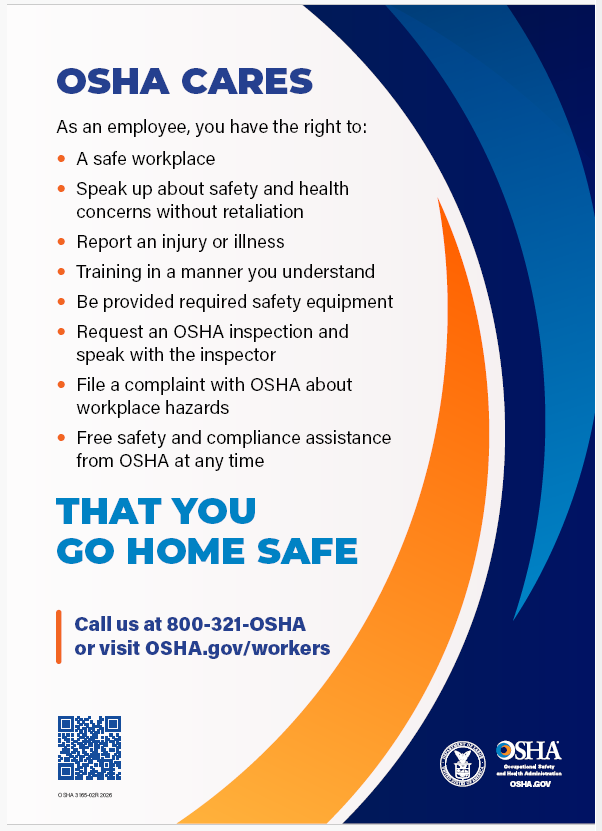
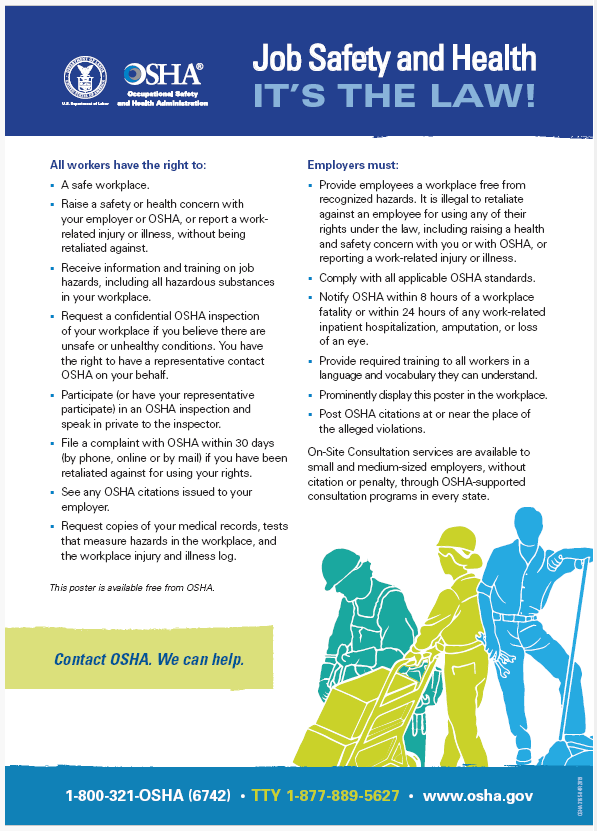
Which is why OSHA has for many years required a poster entitled “It’s the Law” to be posted in all workplaces. You will notice that this poster (on the left) includes both employee rights, as well and employer responsibilities. Because not only is it important for employers to understand what is required by them under the Occupational Safety and Health Act, but it’s also important for workers to know what their employers are required to do.
The New Poster
Now check out the new poster. The title has been changed from “Job Safety and Health: It’s the Law,” to “OSHA Cares…That You Go Home Safe.”
OSHA explains this by claiming that “We want every worker to know that OSHA cares about their wellbeing and is here to help ensure that they go home safe — whether by addressing concerns, providing resources, or offering compliance assistance to employers. The poster that all employers covered by OSHA are required to display in their place of business is meant to remind workers that we are here for them.”
But does “OSHA Cares” transmit the same strong message as “It’s the Law?”
I would say no. I mean, that “OSHA Cares” about my wellbeing is very sweet and heartwarming. Everyone wants to be cared for. And who doesn’t want someone to care that they come home alive and healthy at the end of every workday?
But knowing that a government agency — or your employer — “cares” about you, is not the same as knowing that the law requires your employer to “Provide employees a workplace free from recognized hazards” or that the law allows you to exercise your rights under the law without being retaliated against.
The Details
OK, so perhaps reasonable minds can differ about the rhetorical difference between “OSHA Cares” and “It’s the Law.” But let’s actually compare the wording of the two posters.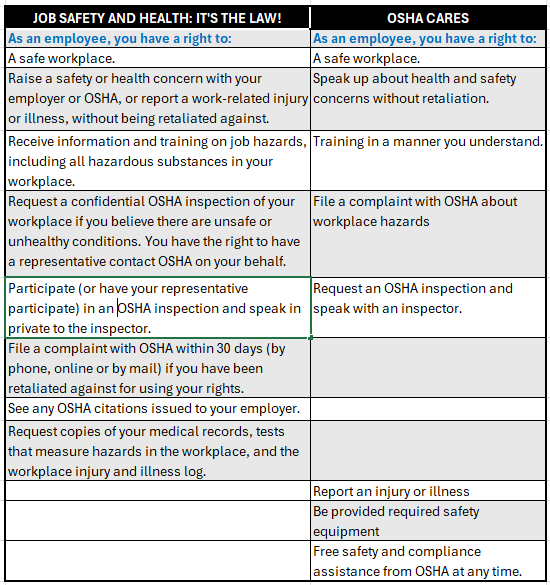
- Both say that employees have a right to a safe workplace. So far, so good
SPACE - The next line of both posters deals with an employee’s right to “speak up” or raise safety or health concerns without being retaliated against. Not sure what “speak up” means? Maybe at the bar after work? The old poster is much more explicit that raising concerns “with your employer or OSHA” — and the right to “report a work-related injury or illness.”
SPACE - Line 3 of both posters deals with a worker’s right to receive training and information (although “information” is missing from the new poster.) The new poster also mentions training “in a manner you understand” which is covered more explicitly on the employer side of the old poster which states that training must be provided to workers “in a language and vocabulary they can understand.”
– - The next couple of lines address a worker’s right to “file a complaint” and request an OSHA inspection. The new poster simply says that employees have the right to “File a complaint with OSHA about workplace hazards,” and then below that to “request an OSHA inspection and speak with an inspector.
–
The old poster goes into more detail explaining first, that a complaint can be confidential, that you can file “if you believe there are unsafe or unhealthy conditions,” and that “You have the right to have a representative contact OSHA on your behalf.” It’s vitally important that workers understand that, if they fear retaliation, a union rep or another representative can request an inspection on their behalf. The new poster completely ignores any mention of a worker representative (usually a union.)
–
The language in the old poster is also important because workers are often afraid that if they file a complaint about a suspected unsafe condition, they will somehow get in trouble it later turns out they were wrong.
–
The old poster also assured workers that they could “Participate (or have your representative participate) in an OSHA inspection and speak in private to the inspector.” This important legal ability for workers to participate in an inspection or let their representative participate, and speak in private to an inspector are completely missing from the new poster.
– - The old poster has several other important sections missing from the new “OSHA Cares” poster. There is no mention in the new poster that employees have only 30 days to file a discrimination complaint. The OSHAct give employees one of the shortest windows of any whistleblower law to file retaliation complaints and many workers miss the short deadline because they aren’t aware of it. Other, most more modern whistleblower laws allow much more time — up to six months — to file a complaint.
– - The old poster notifies workers that they have the right to “See any OSHA citations issued to your employer.” This, along with the notification on the employer side of the old poster requiring employers to “Post OSHA citations at or near the place of the alleged violations” are important to ensure that workers know when their employers have been cited, what standards they have violated, what they must do to fix a safety or health problem and how long they have to fix it. None of this is mentioned in the new poster.
– - The old poster tells workers that they have the right to “Request copies of your medical records, tests that measure hazards in the workplace, and the workplace injury and illness log.” The right to request this information is missing from the new poster. Again, this information is crucially important for workers to be able to determine what they are being exposed to, who in their workplace has been injured and that OSHA will have access to accurate injury and illness information in their workplace.
– - Now, the new poster has a few items missing from the old poster. For example it tells employees that employers must provide them with required safety equipment. That’s good, although it doesn’t mention that most safety equipment must be provided free of cost to employees. The new poster also has one of those new-fangled QR Codes that directs your phone to OSHA’s “OSHA Worker Rights and Protections” webpage.
– - And finally, the most curious and confusing part of the new poster is the assurance that workers can obtain “Free safety and compliance assistance from OSHA at any time.” If they’re referring to OSHA’s Onsite Consultation Program, they’re wrong. The Onsite Consultation program provides free, “inspections” for small and medium size employers, without enforcement, to provide them with assistance on any health and safety problems identified in their workplaces. But only employers can request such consultation visits, not workers. If they’re just saying that employees are allowed to look stuff up on OSHA’s website, well whoopsie doo!
Finally, the announcement of this new poster states that “It is ok to display an old version of this poster.”
Good to know. But for how long before only the “OSHA Cares” poster is mandated?
The employer side
Let’s not forget the major missing part of the new poster: the employer responsibility side. Nowhere on the new poster will employers (or workers) learn that the law requires employers to “comply with all applicable OSHA standards,” “notify OSHA within 8 hours of a workplace fatality or within 24 hours of any work-related inpatient hospitalization, amputation, or loss of an eye,” or even that employers are required to “Prominently display this poster in the workplace.”
With no mention of employers in the new poster, will workers be left to believe that it is OSHA’s job to make workplaces safe, not the employer’s.
And with no mention of employers in the new poster, will workers be left to believe that it is OSHA’s job to make workplaces safe, not the employer’s.
For employers who care, there is a more complete list of employer responsibilities on an OSHA website here, and an actual publication here.
Will a poster for employers be published in the future? Who knows?
Bottom Line
Now, some may say that all this whining about a stupid poster is a silly side show. What’s most important is OSHA’s ability to issue protective standards, inspect unsafe workplaces and issue meaningful penalties to employers who endanger their workers. That’s true, and as we’ve written many times before, OSHA’s not doing very well with all that either.
But as I wrote at the beginning of this piece, the ability of workers to easily understand their rights (and their employer’s responsibilities) under the OSHAct are crucial to the successful implementation of the law — and the ability of workers to come home safe and healthy at the end of the day.
This poster is often the first, and sometimes the only contact workers will have with their rights under the law and it’s important that the poster give them as complete an understanding of their rights as possible. Unfortunately, the new poster leaves many of the most important rights out — the ability to request medical records and injury/illness logs, the ability of a worker representative to file a complaint and participate in an inspection, and notification that workers only have 30 days to file a retaliation complaint.
And although the law doesn’t require an employer poster, it is also important for employers to understand their obligations under the law — and for workers to know what their employer is required to do to protect their health and safety.
The best way for OSHA to show that it “cares” and be there for workers is to ensure that workers have easy access to the most important information.
The new poster fails.
Jordan – as always, thank you for your clear description of the changes being made and their likely impact upon workers’ health and safety. Your piece comes out the same day as news of labor law deform in Argentina, stripping away Peronist era labor protections. See these articles: buenosairesherald.com/politics/argentine-labor-reform-101-what-happens-now-and-all-you-need-to-know,
www.aljazeera.com/news/2026/2/20/argentinas-chamber-of-deputies-passes-controversial-labour-reform-bill
www.theguardian.com/world/2026/feb/27/argentina-labor-law-overhaul
Jordan-
I always appreciate your analysis and mission. This new poster is going to wind up in workplaces over time. I’m thinking about how posters like this present in different kinds of worksites, and recognize they appear along with a lot of other required posters/content. Now may be an opportunity to give feedback to the companies that create the compiled/compliant workplace posters, to give them honest input that the new poster doesn’t/can’t replace the old content. I’m trying to see the benefit of a worker-focused poster that has a different spin, some simpler language, and the potential to lead individuals through the QR code to the worker-focused site. Despite the flaws and the real fear this is going to supplant important messaging on the prior poster, this new design is a real way to get individuals to that website, there is power in that, they can bring it home in their pocket, and it is bringing that worker so many steps closer to engaging with OSHA.
Can you share your thoughts on that worker website?
Great dissection of a narcissistic and flawed effort by the incumbents. It reminds me of the similarly one-sided effort by John Henshaw c. 2001 to offer the slogan “OSHA Adds Value to Your Business and Your Life” on hats and buttons CSHOs and others would wear. I thought that was antithetical to our mission and needlessly self-referential, so I suggested an alternative: “Harm a Worker, Go Straight to Hell, Do Not Collect $200.”
John didn’t like it.