
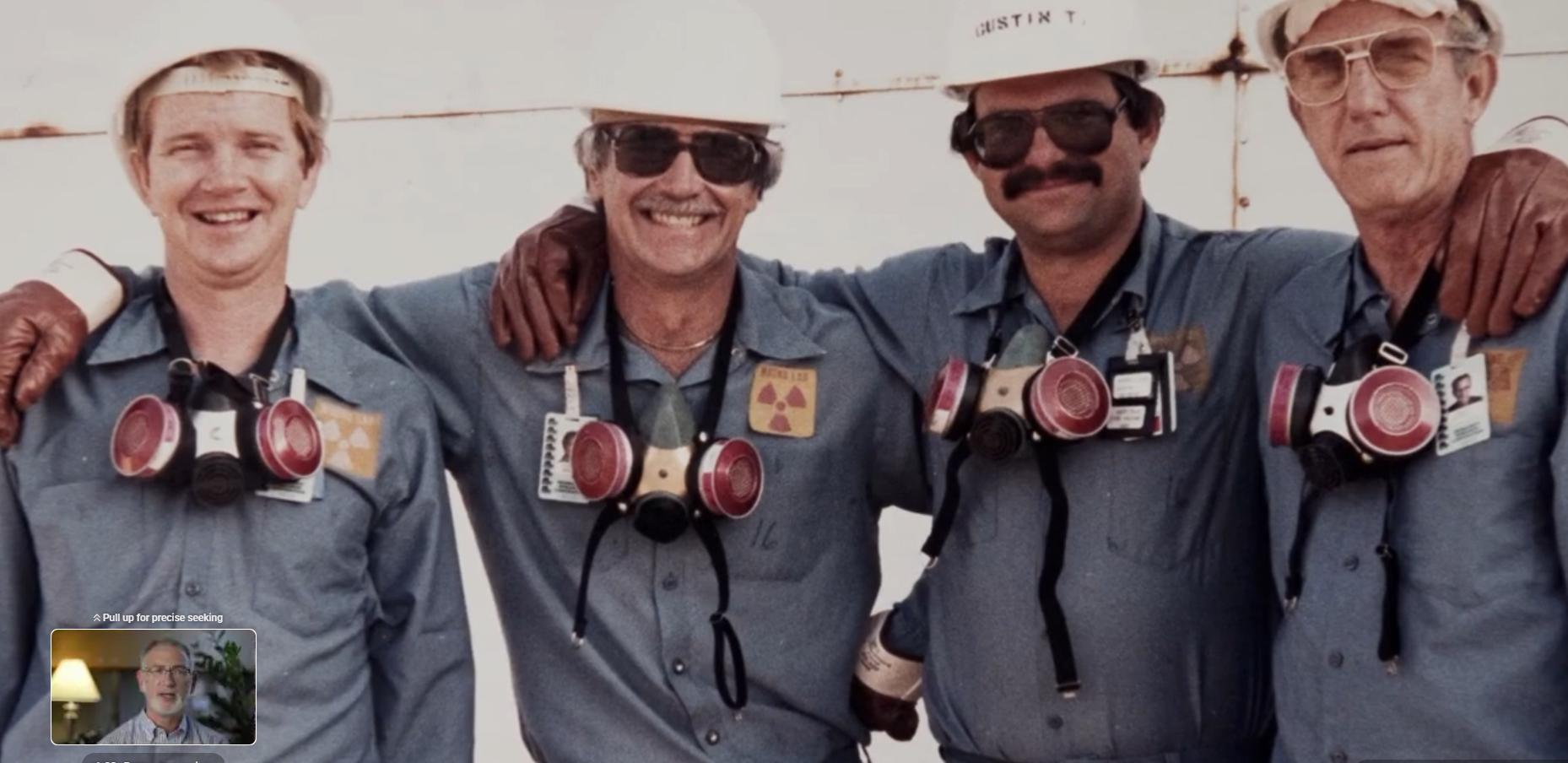
If your job requires you to work with radiation, the Nuclear Regulatory Commission (NRC), whose mission it is to protect public health and safety, worries that you are getting too much protection from radiation exposure.
Yep, you read that right.
To solve this vexing problem, the NRC is preparing to make wholesale changes to the rules covering workplace radiation protection. Changes that will help the nuclear industry…and kill nuclear workers.
Radiation exposure is measured in “rem” — which stands for “roentgen equivalent man.” Rem is a unit used to measure the biological damage and potential health risk of ionizing radiation on the human body.)
The NRC currently requires annual worker radiation doses to be kept below 5 rem. However, 5 rem is not adequate to protect workers, so 50 years ago, the NRC also required radiation doses to be kept “As Low As Reasonably Achievable” (ALARA) which requires that radiation be reduced as far below 5 rem as is “practical”. ALARA is a precautionary principle, but it leaves employers with wiggle room if further dose reduction is not technically feasible or it is uneconomic. The dose limit sets a ceiling, while ALARA requires licensees to consider how to further reduce radiation exposure below that ceiling.
ALARA is based on the “linear no-threshold” (LNT) model (derived from Japanese atomic bomb survivors’ data): the scientific premise that there is no threshold below which there are no adverse health effects from ionizing radiation. In other words, any exposure to ionizing radiation, no matter how small, carries a risk of inducing cancer or other health effects (like heart disease, birth defects, cognitive defects, thyroid and endocrine disorders, genetic mutations, and infertility), and that harm is directly proportional to the amount of exposure. There is no demonstrated radiation exposure level that carries no risk.
There is no demonstrated radiation exposure level that carries no risk.
Thus, for more than five decades, the ALARA principle has served as the foundation for radiation protection in the US and around the world, successfully driving down exposures far below the 5 rem regulatory limit in the US by using workplace protections based on exposure time, distance from the radiation source, and shielding from the radiation.
Now the NRC is proposing to eliminate the 50-year-old requirement that employers keep radiation exposures “as low as reasonably achievable”.
Executive Order Drives NRC to Abandon Well-Established Science
Why is this happening now? Is there any new evidence driving these changes?
No. This action is based solely on an industry wish list incorporated in President Trump’s May 2025 Executive Order 14300 (Ordering the Reform of the Nuclear Regulatory Commission). As he does with most deregulatory actions he tries to push through, Trump justifies the order not on new evidence, but on his desire to “[R]eestablish the United States as the global leader in nuclear energy,” which he calls a “vital national- and economic- security interest.” This means cheaper-to-build and less-costly-to-operate nuclear energy facilities.
To achieve this goal, the Executive Order directs the NRC to “reconsider reliance on the linear no-threshold (LNT) model for radiation exposure on which the “as low as reasonably achievable” standard” is based.
Trump justifies the order not on new evidence, but on his desire to “Reestablish the United States as the global leader in nuclear energy,” which he calls a “vital national- and economic- security interest.” This means cheaper-to-build and less-costly-to-operate nuclear energy facilities.
The Executive Order declares, without evidence, that the LNT model is “flawed.” However, the LNT model has been validated by the largest epidemiology study of atomic workers ever undertaken. The INWORKS study pooled 309,932 workers in the nuclear industry in the United States, United Kingdom, and France and examined cancer risks using individual occupational exposure records collected through personal dosimeters worn by workers throughout their careers. The study reaffirms the LNT model which shows that risk of cancer mortality is proportional to the dose received even at low doses of ionizing radiation.
The NRC is now claiming that its longstanding principle that radiation dose be kept as low as reasonably achievable is driving the nuclear industry to make “irrational” decisions in reducing radiation exposure, contending that “continuous dose reductions even to very low doses of radiation have often been applied without a reasonable stopping point.” The NRC cited no evidence to support this contention.
While the NRC proposes to retain the 5 rem annual exposure limit, its new rule allows worker exposures to be doubled 10 rem in a year under what it calls a “planned occupational dose limit extension,” provided there is unused radiation dose that can be borrowed from previous years.
The NRC sees any amount of radiation below 5 rem in prior years as an “exposure” bank that can be drawn upon by the employer to exceed dose limits. In other words, if a worker is below the 5 rem level for one year, they can be exposed to more radiation the next year.
In plain English, what that means is that keeping radiation exposure too low is cutting into the profits of the companies exposing workers to cancer-causing radiation and slowing the development of new nuclear power stations.
And operators can even increase exposures up to 25 rem in a given year by “borrowing” the available “unused” radiation dose from the previous 4 years.
The NRC is suggesting that using ALARA to drive the dose below 5 rem is a waste of time and money. In fact, NRC argues – again without evidence — that “current implementation of the ALARA principle allows for excessive subjectivity in the expectations for dose reduction measures, oftentimes resulting in overly conservative outcomes,” and that this could result in “significant economic costs and operational and licensing inefficiencies without commensurate public health and safety gains.”
In plain English, what that means is that keeping radiation exposure too low is cutting into the profits of the companies exposing workers to cancer-causing radiation and slowing the development of new nuclear power stations. The NRC projects this rule will save employers only $9.53 million each year – nationwide –—a trivial sum compared with the increased costs to workers (and our medical system) from higher cancer rates.
See No Evil: NRC Celebrates the Benefits of Higher Worker Exposure
To make sure no one knows how damaging this change is to workers, the NRC consciously decided not to estimate increased cancer risks in its cost-benefit analysis.
The NRC even celebrates the “benefits” of increasing worker exposure in its regulatory analysis, since this “would, in some cases, allow work to be completed by fewer workers in workspaces where they would be exposed to ionizing radiation, which would provide labor savings.”
The new rule would mean that workers could spend more time exposed to higher levels of radiation and an employer would not have to hire and rotate as many workers. This rule converts these workers into radiation sponges.
To reduce individual worker exposure over any given time period, employers often rotate workers out of their positions to prevent overexposure. So, translated, the new rule would mean that workers could spend more time exposed to higher levels of radiation and an employer would not have to hire and rotate as many workers. This rule converts these workers into radiation sponges.
Another cited “benefit” is “there would be lower equipment costs in cases where less shielding is required for new equipment.”
We have written before about this administration’s abuse of cost-benefit analysis. Under normal administrations, before Trump, “costs” are what employers will have to pay to implement a new regulation (e.g., training, recordkeeping, new equipment or workers). “Benefits” are lives saved or injuries or illnesses prevented.
If the benefits (of saving lives or reducing illness) outweigh the costs of compliance to employers, that’s generally considered to be a good thing.
The Trump administration, however, just considers the costs to employers and doesn’t bother balancing those costs with the benefit of saving lives.
“Benefits,” under Trump, have been transformed into the benefits to employers of reducing their costs to comply with the old rules. In this case the benefits are enabling employers to lower costs by increasing radiation exposure and reducing radiation shielding.
The corresponding “cost” to workers – in more illness and more death – are ignored.
What Are the Costs of Zapping ALARA and Who Pays?
The NRC’s proposal avoids estimating the risk from eliminating ALARA, claiming there would be “insignificant impacts to health and safety” in its regulatory analysis. Despite having a model to estimate the societal costs of increased cancer risks, the NRC claims that it lacked exact dose information to undertake this task.
Under the NRC’s dose relaxation scheme, for workers exposed to the 5 rem regulatory limit over a 40 year career, the excess cancer risk above what the population already incurs (the baseline) will increase to 1 out of 5 workers (or an additional 20%) getting cancer.
Put another way, if 1,000 workers were exposed to 5 rem for 40 years (200 rem), this group would incur 206 additional cancers (C.I. 113 to 350 on top of the baseline cancer risk–nearly doubling the lifetime risk of getting cancer. (This risk estimate is based on the atomic bomb survivor group using the National Cancer Institute model.)
Of course, none of the swivel chair bureaucrats writing this rule will be exposed to the doubling of cancer risks they disparage as “insignificant.” The NRC says it plans to issue additional guidance using a “graded” approach to radiation protection, but this has not been issued, and it is unclear whether this will limit radiation dose.
Atomic Workers and Medical Experts Reject Threats to their Health and Safety
Over 2,000 comments were filed by unions, environmental groups, physicians, attorneys general, professional associations, industry funded groups and concerned individuals by the August 31 deadline—the preponderance opposed this rule.
The United Steelworkers Union (USW), which represents around 10,000 atomic workers in nuclear fuel production, naval nuclear shipyards, and DOE nuclear weapons complex facilities, is not happy with this scheme. The USW wrote:
radiation risk is driven by cumulative exposure, and higher doses received in a single year cannot be undone simply because a worker received a lower dose in a previous year. From a worker protection perspective, the relevant question is not whether an exposure remains compliant when averaged over several years, but whether the exposure could have been reasonably avoided in the first place.
Similarly, the American Society of Radiologic Technologists (ASRT), which represents 154,000 medical imaging technologists and radiation therapists, opposed eliminating ALARA. They wrote:
ASRT has significant concerns over the unintended consequences this rule as written will have on access to critical healthcare and safety of patients and healthcare workers. Therefore, ASRT must oppose the removal of “As Low As Reasonably Achievable” when specifically discussing the use of radiation in health care.
NRC Defended ALARA Before It Opposed It
This newfound zeal for irradiating workers is a 180-degree reversal from 2021 when the NRC denied a petition for rulemaking seeking to eliminate ALARA. Just five years ago, the NRC rejected arguments that ALARA was uneconomic and stifled innovation stating, “[the] NRC has determined that current ALARA requirements … reasonably account for economic considerations.”
That made sense, given there is no threshold below which there are no adverse effects from ionizing radiation.
The only explanation NRC offers for its head spinning reversal is that it was directed to implement the President’s Executive Order—a document which has the legal significance of an interagency memo.
Will Congress Step in Front of this Fast Moving Train?
Senators Patty Murray (D-WA) and Representative Marcy Kaptur (D-OH) have taken note. On September 21, they wrote NRC demanding justification for rolling back ALARA and expressed alarm that this proposal “could threaten workers’ safety at nuclear facilities and impair independent oversight.”
As senior members of the appropriations committees in the Senate and House of Representatives, they will be in a position to alter the trajectory of this rule if Democrats take control of the Senate and/or House this Fall. The NRC currently plans to finalize the rule by February 17, 2027.
This entire article is an exercise in presentation of deadly falsehood, malignant, cultist junk science, and quack medicine.
The LNT model for biological effects of radiation on humans is shown grossly false by near every study of the biological effects of radiation on humans done over the last 100 years. As a life long Maxcist, Harvard trained scientist, and MD who has specifically studied biological effects of radiation, I know what malignant utterly false rubbish this entire article is. That anyone … union or other… ostensibly in support of the interests and rights of working people, would promote such falsehood and lies as you offer here is an embarrassment to socialism and the workers movement. Fortunately, it requires a high level of ignorance of science and medicine in general, and of the subject of biological effects of radiation on humans to see this as other than an obvious collection of lies, falsehood, and rubbish. This article reads like one arguing that MMR vaccine causes autism, or for creatiionism, or that the earth is flat. It has about as much scientific and medical validity as any of those.
Shame on you for printing such garbage!
If you’d like to learn some facts about energy policy and biological effects of radiation, read “The LNT Story” by Mike Conley, and “The Earth is a Nuclear Planet” by Mike Conley and Tim Maloney. To name two very recent and among the best of dozens of books on this subject.
This article is obviously written by profoundly science and medicine ignorant cultist true believers in lunatic dogma. I rather doubt those behind it, like other cultists, will ever want to look at something that challenges their profoundly science and medicine ignorant faith and the deadly dogma they believe.
Martin H. Goodman MD
Director, Riazanov Library radical digital archive projects
[…] NRC Wants to Bulldoze Workplace Radiation Protections Confined Space […]
Great, more Fossil fuel industry propaganda, and Americans are so poorly educated that they will believe it.
LNT has been widely rejected in the scientific community due to clear and overwhelming evidence that the health effects of radiation do not work like that.
[…] NRC Wants to Bulldoze Workplace Radiation Protections […]