
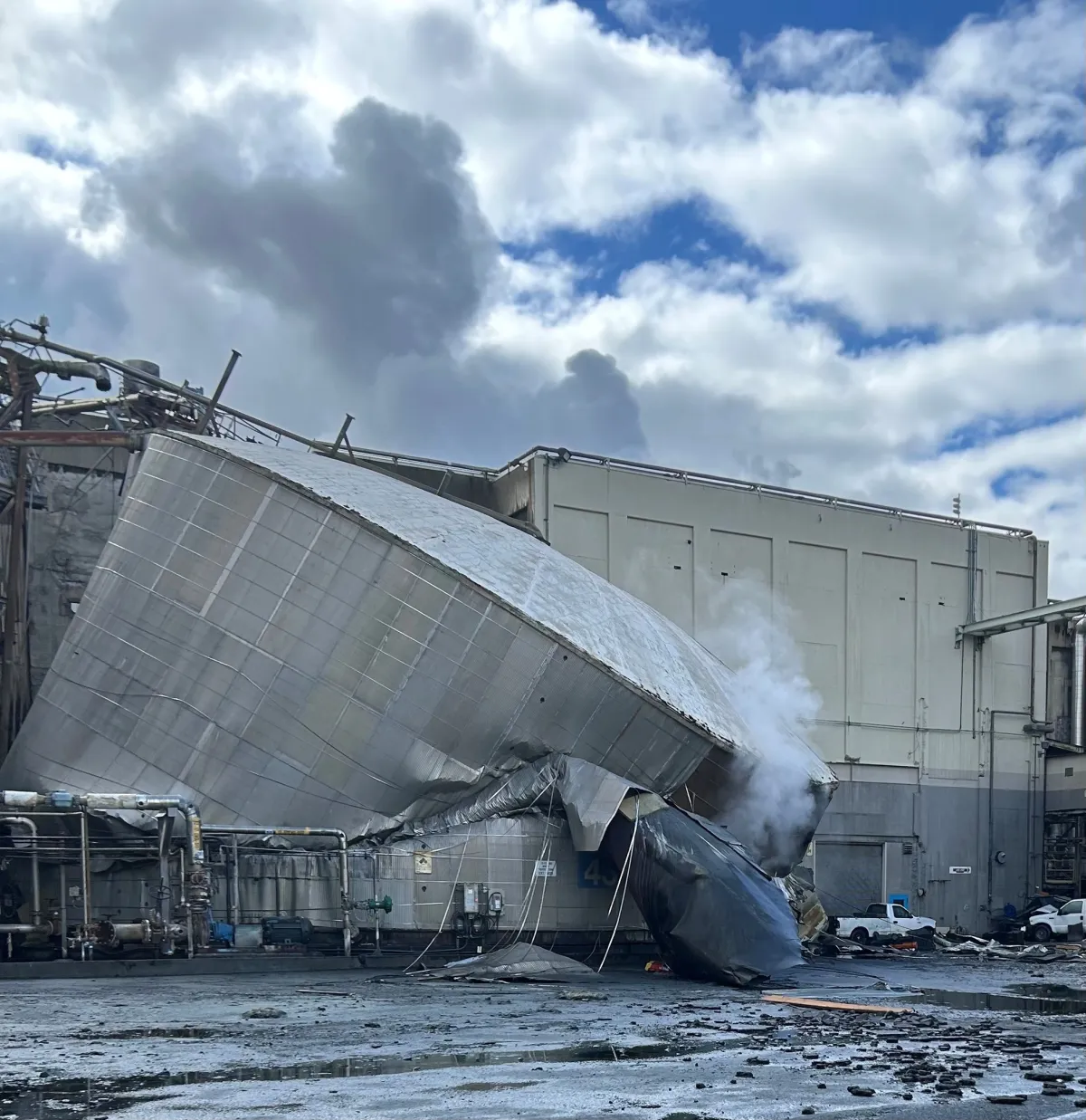
Two recent mass casualty explosions have resulted in record OSHA penalties. On May 6, 2026, the G Tank at the Nippon Dynawave Packaging Co. mill in Longview, Washington, failed, spilling 900,000 gallons of caustic white liquor that flooded the paper mill site. The incident killed 11 workers and injured 12 others.
Late last week, Washington states Labor and Industries agency (L&I), which houses the state OSHA, issued the largest fine in the state’s history — citing the company for 75 workplace safety and health violations and issuing $9,177,127 in penalties. The previous largest fine, of $2.9 million, was issued after the Tesoro refinery explosion in 2010. The Washington State Department of Ecology has also imposed $961,000 in penalties for environmental violations and recovery costs.
The explosion and deaths were particularly infuriating considering that investigators found that “Nippon had knowledge, at least as early as August 2025, that the walls of G-tank were far too thin and the tank was not fit for service. Yet they failed to act on that knowledge to protect their workers from disaster.” L&I also found problems with other tanks, as well as serious shortcomings with Nippon’s emergency response plan and training.
As a result, L&I cited the company for 43 egregious willful serious violations — one for each week the company kept the tank in operation without changes after they received the initial report detailing the tank’s weaknesses. Willful citations mean the employer knowingly or intentionally failed to comply or acted with plain indifference to safety rules.
L&I Director Joel Sacks stated that
“Our findings are shocking and heartbreaking. Nippon Dynawave had all the information they needed to act, but they didn’t listen to alarms their consultants and staff were raising. Tragically, there are 11 families whose loved ones never came home as a result, and many others whose lives will be changed forever,”
Because Nippon’s safety and health violations were both willful and contributed directly to the deaths of their workers, L&I will also refer the case for criminal prosecution.
“High Likelihood of Failure”
The G tank was built in the 1980s. Forty five years later, the company hired a contractor to conduct an evaluation of the safety of the tank. The findings: “Exterior ultrasound testing shows thickness of tank walls significantly below minimum safe levels, as determined by the American Petroleum Institute’s engineering standards (API 653). Report from the inspection company says the tank is “not fit for continued service unless corrected. High likelihood/consequence of failure.”
When corrosion causes a tank’s wall thickness to fall below the minimum safe level, API 653 directs employers must do one of the following:
- Repair it.
- Reduce pressure on the walls by limiting how much liquid goes in, or
- Take it out of service.
Responding to the urgency of the report, Nippon acted by doing nothing.
Instead, they apparently hoped that the problem would cure itself, and they retested the tank wall thickness three months later. And surprisingly, the same result. Managers discussed conducting monthly monitoring of wall thickness, but nah!
And just to make really, really sure there was a problem, the company conducted additional testing in February 2026. The problem was worse.
So what to do? In late 2025, Nippon Dynawave Packaging Co. managers sought approval from Nippon Paper Industries, their parent company, to include G-tank replacement in their 2026 capital budget because the tank “had reached the end of its safe service life.”
But, hey, there are always other priorities. After months of discussions, the local plant was told by the parent company that they would have to reduce other capital expenses before adding any G-tank replacement to the 2026 budget. So, they choose to prioritize other projects.
And the G tank was not the only tank on the property that had potential problems that Nippon ignored. There were 28 other tanks that required inspections, but L&I found that Nippon did not have appropriate documentation that they’d conducted the required testing or followed up on required inspection recommendations.
Nippon’s safety program was based on hope, prayers and luck. They chose to prioritize other projects, hoping and praying their luck would hold out. Unfortunately, hope failed, prayers went unanswered and luck ran out.
Nippon’s safety program was based on hope, prayers and luck. They chose to prioritize other projects, hoping and praying their luck would hold out.
Unfortunately, hope failed, prayers went unanswered and luck ran out.
G tank normally fed white liquor into a digestor which breaks wood chips down into pulp. At 4:00 am, the morning of May 5, the digestor shut down and the G tank filled to the top. At that point, according to the L&I investigation, the pressure at the bottom of the tank was more than 200% the stress capacity. At 7:08 am, the tank began to fail. An hour later, 11 workers were dead.
Those 11 workers killed were Jared Ammons, 35, Norman Barlow, 58, Gilbert Bernal, 52, Bradley Covington, 27, Tyler Covington, 29, Clinton “CJ” Doran, 26, Braydon Finkas, 38. John Forsberg, 51, Dale Miller, 54, Dillon Miller and Robert “Robb” Wilson, 48.
Emergency Non-Response
Not only did Nippon’s negligence kill 11 workers, but their emergency response program was also faulty, leading to more injuries. According to the law, plants are required to
- Establish an effective, employer-led incident command.
- Sufficiently brief emergency responders.
- Communicate with other employers on the same property about what was happening,
- Set up an effective boundary around the spill.
As with tank negligence, Nippon failed to comply with these emergency response requirements. It was left to outside agencies’ emergency responders to establish the first effective overall incident command after they arrived at the scene. The other businesses on the scene received no communication and were forced to reach out to them repeatedly for directions on what their workers should do. In addition, Nippon failed to set a boundary around the spill, allowing employees to access the area of the spill hours after the tank collapsed, while the stie was still flooded with dangerous chemical material.
D&I found that failures in the response were a contributing factor in serious injuries to four of the 12 workers who were hurt.
Meanwhile, in Tennessee
Meanwhile, just over a year ago, on October 10, 2025 Building 602 at Accurate Energetic Systems’ facility in McEwen, Tennessee, exploded, killing all 16 employees inside.
Accurate Energetic Systems, LLC (“AES”) is an explosives manufacturer located in McEwen, Tennessee. AES manufactures explosive products for military, aerospace, mining, avalanche control, and commercial demolition markets. The high explosives at the facility were highly sensitive and could be accidentally ignited by heat, friction, or impact.
Last April, Tennessee OSHA announced that it had identified 100 safety violations at the AES plant, with at least 44 described as “willful-serious,” along with a $3,133,900 penalty. This was TNOSHA’s highest penalty in history. The previous-largest penalty TOSHA had assessed was nearly $380,000 after its investigation into a 2001 explosion at a military flare manufacturer that resulted in the death of an employee.
Because of the complete devastation at the site, it is still unclear exactly what caused the explosion. But the TNOSHA investigation did find
a dangerous buildup of explosive dust on equipment and in ventilation systems — a well-known ignition risk in facilities that handle energetic materials.
Inspectors also documented workers spraying flammable paint near hot equipment, without adequate safeguards to prevent ignition.
And in several cases, the company failed to maintain or provide access to basic safety information required under process safety standards — including process flow diagrams, electrical hazard classifications and ventilation system documentation.
TNOSHA’s report also
found evidence that Accurate Energetic Systems had not taken adequate precautions to prevent the ignition of flammable vapors being handled at the facility. The agency said the company also failed to maintain required safety information for its hazardous equipment and demonstrated plain indifference to employee safety.
“AES, despite clear knowledge of the industry standards and recognized explosion hazards in Building 602, continued operations with excessive personnel, unnecessary occupancy, and explosive quantities far beyond the minimum needed for safe and efficient operations,” investigators said in their report.
“AES demonstrated plain indifference to employee safety by failing to limit personnel present, duration of employee exposure, and amount of explosive material present during operations in Building 602 that exposed employees to known explosion, fire, and blast hazards,” the investigators said. “AES increased limits including the net explosive weight, personnel, and transient limits for Building 602 without documented basis demonstrating intentional disregard for industry standards.”
The Chemical Safety Board (CSB) is also investigating the explosion. The CSB issued a preliminary report last April which described how the plant operates.
Several families are also suing the company for wrongful death. AES claims that “TOSHA’s findings do not represent the standard of safety we strive to achieve every day, nor our commitment to the wellbeing of our team members and their loved ones,” and that workers comp law prevents families from suing them.
It is not clear whether Tennessee OSHA referred the company for criminal prosecution.
The 16 victims of the AES explosion were identified as: Jason Adams, Erick Anderson, Billy Baker, Adam Boatman, Christopher Clark, Mindy Clifton, James Cook, Reyna Gillahan, LaTeisha Mays, Jeremy Moore, Melinda Rainey, Melissa Stanford, Trenton Stewart, Rachel Woodall, Steven Wright and Donald Yowell.
Conclusion
Both of these incidents caused mass casualties — multiple deaths and injuries — as a result of gross and knowing negligence on the part of the employers. Both the incdents themselves and the resulting penalties gained national attention — for a few minutes. National attention because the the large numbers of fatalities.
But remember. Close to ten times as many workers die each week in this country as died in the Nippon tank collapse, and six times as many each week as died in AES. Although most of these workers die as the result of the same negligence we saw at Nippon and AES, no one ever hears about them because they die one at a time, instead of multiple deaths in a single incident. Unlike the headlines we saw at AES and Nippon, most workers receive little attention, except possibly in the local news, and are soon forgotten, except by family, friends and co-workers. We often never even learn their names.
Something to think about….
When dealing with volatile agents, specific atmospheric pressures change outcomes significantly. Cordial Cliff